

No Cuff, No Squeeze: How Hilo Tracks Blood Pressure From Your Wrist
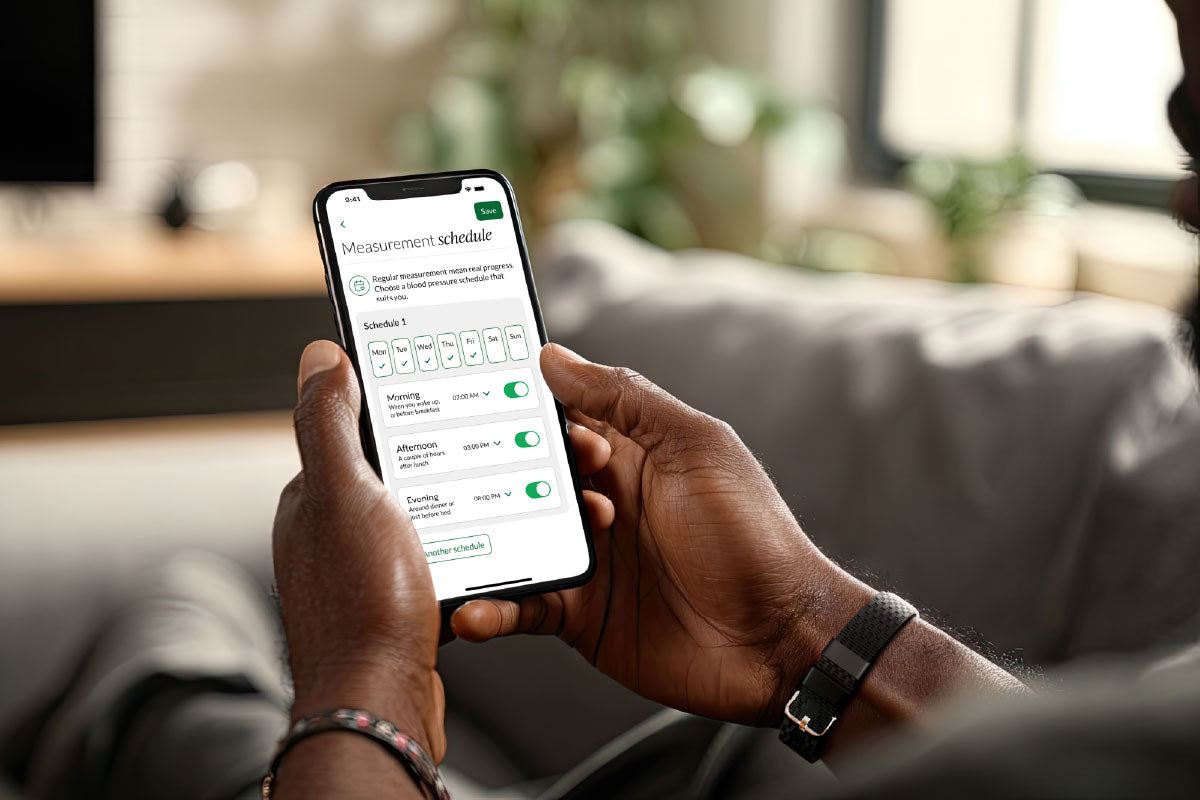
Most people know what an upper-arm blood pressure cuff feels like. It tightens around the arm, pauses, releases, and displays a reading. Hilo Core works through optical sensing at the wrist instead — “no cuff, no squeeze” applies to those background observations. The included upper-arm cuff remains the system’s reference, and cuff readings stay labeled separately from wrist-derived trends in the app.
Key Facts
- Hilo Core uses PPG to observe pulse-wave signals at the wrist: It records optical signals during suitable moments of daily wear — without an inflation cycle for every observation.
- A validated upper-arm cuff establishes the personal reference: Guided cuff readings anchor the system. The cuff also provides point-in-time reference values whenever a deliberate reading is needed.
- The app organizes observations into a longer record: Cuff readings and wrist-derived trends appear in separate views, so the source of each data type stays visible.
- Hilo Core is a wellness system, not a clinical measurement device: The cuffless band supports awareness of longer-term patterns. Clinical decisions rely on validated cuff-based measurements and qualified healthcare professionals. Explore Hilo Core.
How Can a Wristband Track Blood Pressure Patterns?
Cuffless technologies infer blood-pressure-related information from physiological signals. Many use PPG or tonometry, sometimes combined with pulse transit time, pulse arrival time, pulse-wave analysis, or machine learning. The 2026 American Heart Association scientific statement explains that outputs from many cuffless devices represent change relative to a calibration reference instead of a direct pressure measurement. Read the AHA scientific statement on cuffless blood pressure devices.

Hilo Core uses PPG and pulse-wave analysis in its cuffless component. Guided cuff readings establish a personal reference. During daily wear, the band records optical pulse-wave signals when contact and motion are suitable and the signal passes quality checks. The app then shows how the wrist-derived trend develops over days and weeks.
Blood pressure is the organizing metric in the app. Deliberate cuff readings and the longer cuffless record appear in separate views.
The Hilo Core System
| Component | What it does | How to use the information |
|---|---|---|
| Validated upper-arm cuff | Provides validated, point-in-time blood pressure readings and the system’s reference. | Use for structured reference measurements and conversations with a health care professional. |
| Cuffless band | Records optical pulse-wave signals at the wrist during suitable moments. | Follow longer-term wellness trends from intermittent observations. |
| Hilo app | Displays cuff readings and wrist-derived trends in clearly identified views. | Review changes across days and weeks while keeping the source of each data type visible. |
What the Validated Upper-Arm Cuff Measures
A conventional upper-arm cuff uses an inflatable cuff around the arm. As cuff pressure changes, the device detects oscillations produced by blood moving through the brachial artery. Its algorithm estimates systolic and diastolic pressure from those oscillations.
Reliable measurement depends on more than the cuff itself. Cuff size, arm position, back and foot support, a quiet rest period, and the absence of talking all affect the result. The 2025 AHA/ACC High Blood Pressure Guideline recommends standardized technique, validated cuff-based devices, and averages based on repeated readings. The guideline also advises against using cuffless devices for the diagnosis or management of high blood pressure at this time.
The upper-arm cuff used with Hilo Core has been evaluated under the ANSI/AAMI/ISO 81060-2:2013 protocol. Read the peer-reviewed cuff validation study. The included cuff keeps setup and later reference readings within the Hilo Core system, with the app guiding the process from one place.
What the Hilo Core Band Senses at the Wrist
Hilo Core uses PPG, an optical sensing method found in many wearable sensors. Green LEDs send light into the tissue at the wrist. Some light is absorbed, and some returns to the sensor. Blood volume changes with every heartbeat, which changes the reflected signal and creates a pulse waveform.
Heart-rate tracking mainly uses the timing between beats. Pulse-wave analysis examines more of the recorded signal, including its contour and timing, along with relationships among waveform features. The system evaluates usable waveform segments in relation to the wearer’s cuff-based references.
The cuff supplies the point-in-time reading in millimeters of mercury. The cuffless band contributes the longer trend record. This division keeps the reference measurement available while reducing the need for repeated cuff inflation during background observation.
How Hilo Core Turns Wrist Signals Into a Longer Record
Five steps connect the wrist-based optical signals to the trend view in the app. Each step builds on the previous one, with the validated upper-arm cuff anchoring the process from the start.
1. Guided cuff readings establish the reference
Setup begins with the included upper-arm cuff. Optical pulse waves vary from person to person because wrist anatomy, sensor contact, vascular characteristics, and other physiological factors influence the waveform. A personal cuff reference gives the system information tied to the individual wearer. The app prompts additional reference readings when the system requires them.
2. The band records pulse-wave signals during daily wear
The PPG sensor looks for optical signals at the wrist while the band is being worn. Collection runs in the background, without an arm inflation or a manual trigger for every observation. The number of usable observations varies with wear time, movement, sensor contact, and signal quality.
3. Signal-quality checks determine which segments are used
Motion can distort a wrist PPG waveform. A loose band, an active arm, or inconsistent skin contact may introduce noise. Hilo Core applies signal-quality checks and uses optical segments only after they meet its criteria.
The AHA statement identifies motion, sensor position, body posture, and hydrostatic pressure as practical sources of error in cuffless sensing. Hydrostatic pressure changes when the wrist sits higher or lower than the heart. Each moment differs in how well it supports an optical observation.
4. Pulse-wave analysis evaluates the waveform
For segments that pass quality checks, Hilo Core examines waveform shape and timing, along with other relevant features, in relation to the cuff-based reference. These segments support direction and consistency in the trend view. Point-in-time clinical readings remain with the cuff.
5. The app organizes observations across time
A single moment says little about whether a shift will recur. Repeated observations show whether it appeared once, returned over several days, or persisted for longer. In the app, cuff readings remain identified as reference measurements, while wrist-derived information appears in the cuffless trend view.
Why a Series Can Add Useful Everyday Context
Blood pressure changes during the day. Time of day, posture, sleep, movement, meals, stress, and measurement conditions can coincide with those changes. A cuff reading captures one set of circumstances. A series across days can show whether a change was brief, recurring, or sustained.
The trend view can help you explore practical questions such as:
- Was a shift confined to one unusual day?
- Did the pattern look different during travel or a week of less consistent sleep?
- Did a change in routine coincide with a change that continued?
- What did the following weeks look like after the routine returned to normal?
What Hilo Core’s Trend View Is Designed to Show
Hilo Core’s cuffless experience supports awareness of direction and averages across time. It can place those trends alongside everyday factors such as sleep, activity, stress, or recovery. The app keeps the experience focused on blood pressure and leaves the source of each data type visible.
The FDA’s January 2026 general wellness guidance describes how low-risk, noninvasive products may present values, ranges, trends, baselines, or longitudinal summaries and place them in a wellness context. It also draws a boundary around diagnosis, clinical decisions, treatment guidance, and substitution for an authorized medical device. Read the FDA General Wellness guidance.
Hilo Core wellness features are intended to support awareness of longer-term patterns. They are not intended to diagnose, cure, mitigate, treat, or prevent disease. Use appropriate cuff-based measurements and a qualified health care professional for diagnosis, medication decisions, and interpretation of high or low values.
Blood Pressure Awareness That Fits Daily Life
A proper cuff reading takes a few quiet minutes, correct positioning, and attention to technique. Those deliberate checks remain important. They also represent a small part of a week filled with work, sleep, travel, exercise, meals, and family routines.
Hilo Core keeps the deliberate reading and the background record in one system. The included cuff is available for a structured measurement. The cuffless band looks for suitable optical signals during ordinary wear, and the app turns those observations into a longer history. One setup process covers the cuff, band, and app, with both views available in the same place.
Individual wrist observations appear as part of the longer record, without alarms or immediate action prompts. The wearer can follow changes across time without repeatedly stopping for an inflation cycle.
WHEN A VERY HIGH READING NEEDS URGENT ACTION
If your upper-arm cuff shows a reading higher than 180 systolic and/or 120 diastolic, wait at least one minute and measure again.
If the second reading is just as high and you have chest pain, shortness of breath, back pain, numbness, weakness, a change in vision, difficulty speaking, or another new concerning symptom, call 911.
If you do not have symptoms but the reading remains that high, contact your health care professional promptly.
Follow the American Heart Association severe-hypertension guidance.
Do not change medication based on a single reading unless a qualified clinician tells you to.
See Your Blood Pressure Patterns Across Days and Weeks
Hilo Core combines a validated upper-arm cuff with a cuffless PPG band and app — a complete system that keeps both your point-in-time readings and longer-term trends in one place.
Get Hilo CoreDisclaimer: Hilo Core is a wellness product. It is not intended to diagnose, treat, cure, or prevent any disease. It is not intended to measure blood pressure for medical purposes. This article is for general informational purposes only and does not constitute medical advice. Individual health decisions should be made in consultation with a qualified healthcare professional. Hilo Core is not recommended during pregnancy or for individuals with certain cardiac implants or pre-existing conditions. Please consult your healthcare provider before use.
Frequently Asked Questions
Does Hilo Core measure blood pressure continuously?
The cuffless band gathers intermittent optical pulse-wave observations at suitable moments during wear. It does not provide continuous exact clinical blood pressure measurements. The included upper-arm cuff provides the point-in-time reference readings.
Why does Hilo Core need an upper-arm cuff?
The cuff establishes the personal reference used during setup and provides deliberate blood pressure readings when a point-in-time value is needed. It also keeps the reference device inside the same guided system as the band and app.
What is PPG?
Photoplethysmography is an optical sensing method. Green light enters the tissue, and a sensor records changes in reflected light as blood volume rises and falls with each heartbeat. Those changes form a pulse waveform.
Why are some wrist observations left out of the trend view?
Movement, loose contact, or other signal disturbances can alter the waveform. Hilo Core applies signal-quality checks and excludes segments that fall outside its criteria.
Sources
- Jones DW, Ferdinand KC, Taler SJ, et al. 2025 AHA/ACC/AANP/AAPA/ABC/ACCP/ACPM/AGS/AMA/ASPC/NMA/PCNA/SGIM Guideline for the Prevention, Detection, Evaluation, and Management of High Blood Pressure in Adults. Circulation. 2025;152:e114–e218. doi:10.1161/CIR.0000000000001356. Current U.S. clinical guideline supporting standardized cuff-based measurement and advising against cuffless devices for diagnosis or management. Full guideline
- Cohen JB, Byfield RL, Hardy ST, et al. Cuffless Devices for the Measurement of Blood Pressure: A Scientific Statement From the American Heart Association. Hypertension. 2026;83:876–886. doi:10.1161/HYP.0000000000000254. Covers PPG, calibration, pulse-wave methods, motion, sensor position, posture, hydrostatic pressure, and limits on present clinical use. Scientific statement
- Muntner P, Shimbo D, Carey RM, et al. Measurement of Blood Pressure in Humans: A Scientific Statement From the American Heart Association. Hypertension. 2019;73:e35–e66. doi:10.1161/HYP.0000000000000087. Detailed measurement foundation for cuff size, preparation, positioning, repeated readings, and averaging. AHA measurement statement
- U.S. Food and Drug Administration. General Wellness: Policy for Low Risk Devices. Guidance for Industry and Food and Drug Administration Staff. Issued January 6, 2026. Explains when low-risk, noninvasive sensing may be presented for general wellness use and identifies the boundary around diagnosis and clinical management. FDA General Wellness guidance
- Alexandre J, Tan K, Almeida TP, Sola J, Alpert BS, Shah J. Validation of the Aktiia Blood Pressure Cuff for Clinical Use According to the ANSI/AAMI/ISO 81060-2:2013 Protocol. Blood Press Monit. 2023;28:109–112. doi:10.1097/MBP.0000000000000639. Peer-reviewed validation of the oscillometric upper-arm cuff used to provide the system’s point-in-time reference measurements. PubMed record
- American Heart Association. When to Call 911 About High Blood Pressure. Last reviewed August 14, 2025. Current consumer instructions for readings above 180/120 mm Hg, repeat measurement, symptoms, and emergency response. AHA emergency guidance
Read more

Choosing between Hilo Core and WHOOP for blood pressure comes down to one question: is blood pressure the main reason for the purchase, or is it one feature among many? Hilo Core is built around bl...

For most people diagnosed with hypertension, medication is the primary treatment — it is safe, effective, and for many, potentially life-saving. Lifestyle strategies are an important complement: th...
Hilo Core and Apple Watch take fundamentally different approaches to blood pressure. Hilo Core combines a validated upper-arm cuff for point-in-time systolic and diastolic readings with a cuffless ...