

The best time of day to measure your blood pressure
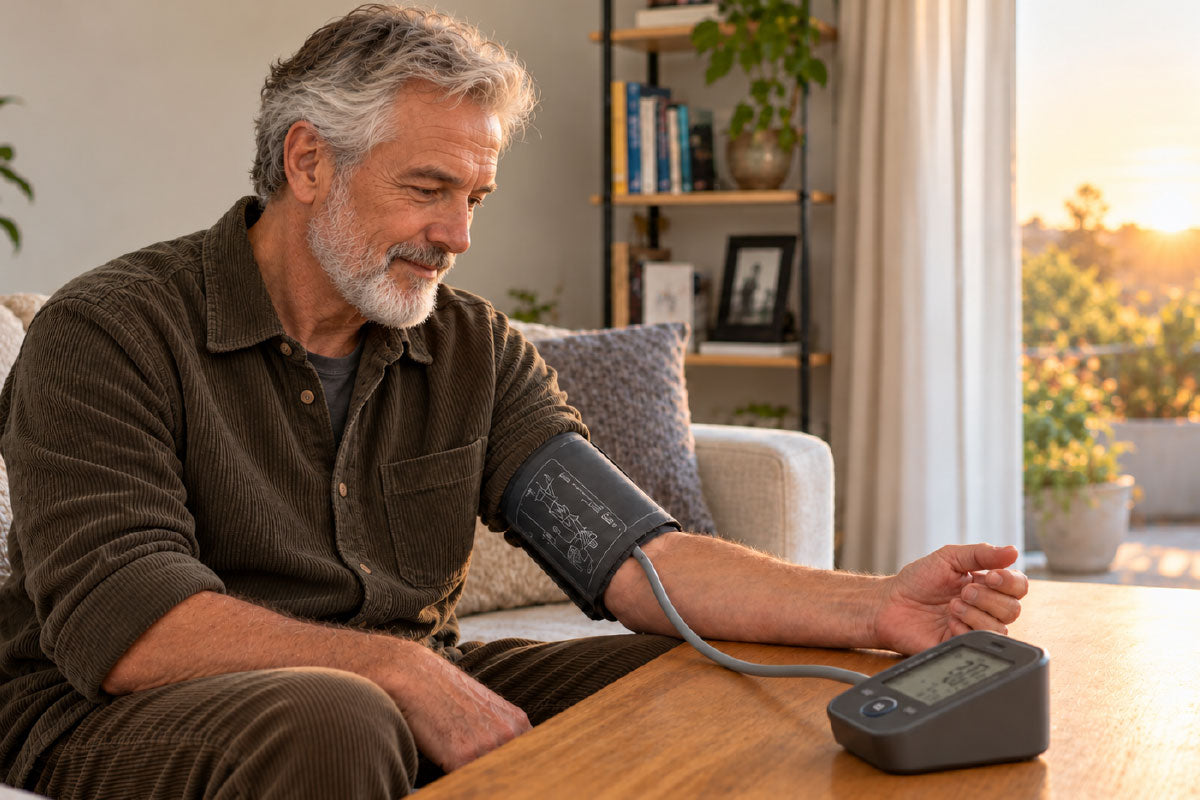
You check your blood pressure before breakfast and get one number. You check again before bed and get a different one. Which reading should you trust? Both can be accurate, because blood pressure moves through the day (American Heart Association). That is why the best time to measure blood pressure matters: when you check changes what a reading can tell you and your doctor. Below, you will find when to measure, how to prepare for each reading, and why the number shifts in the first place.
Key facts
- A daily rhythm: Blood pressure usually rises before and after waking, then tends to fall later in the day. It is usually lower during sleep (American Heart Association).
- Home routine: Take two readings one minute apart in the morning before food or medication and two at bedtime, for at least three days and preferably seven (American Heart Association).
- The morning reading: Cardiovascular events occur more often in the early morning, when blood pressure commonly rises after waking, so your morning reading deserves particular attention (K. Kario, 2010).
- Your own pattern: Hilo Core helps you see how your blood pressure pattern moves across morning, day, and night, between the moments you check with a cuff.
Why blood pressure isn't the same number all day
Your blood pressure follows a daily pattern, often called a circadian rhythm. According to the American Heart Association's scientific statement on blood pressure measurement, blood pressure usually rises before and after waking, then tends to fall later in the day. It is usually lower during sleep.
This rhythm is the reason the time you check matters as much as the way you check. Two accurate readings taken at different times of day can legitimately show different numbers. A morning reading and a bedtime reading are measuring the same blood pressure at two different points in its daily cycle.
A good routine works with this rhythm. Measuring at the same times each day keeps your numbers comparable from one day to the next. The next section sets out that routine step by step.
Best time to measure blood pressure: the routine for reliable readings
When you first start checking at home, Mayo Clinic suggests measuring your blood pressure at least twice daily: first in the morning before eating or taking any medicine, and again in the evening. For a home blood pressure log, the American Heart Association's My Blood Pressure Log sets out this protocol:
- Take two readings one minute apart in the morning, before food or medication.
- Take two more readings at bedtime.
- Measure at consistent times each day.
- Keep the log for at least three days, and preferably seven.
A Finnish study published in the American Heart Association journal Hypertension supports this schedule. Measuring home blood pressure twice in the morning and evening, preferably for seven days or for at least three, provided a thorough picture of a person's blood pressure level (T. J. Niiranen; J. K. Johansson; A. Reunanen et al., 2011).
The morning reading has a few specifics of its own. Mayo Clinic advises against measuring right when you wake up:
- Get dressed and ready for your day first.
- Then check your blood pressure before eating or taking your medicines.
- If you exercise after waking, take your blood pressure before exercising.
Preparation matters at both times of day. Before a home reading, avoid caffeine, exercise, and smoking for 30 minutes; empty your bladder and sit quietly for more than five minutes, as the American Heart Association's measurement statement describes. Mayo Clinic adds a few details:
- Skip alcohol as well during the 30 minutes before a reading. This applies to every reading, whether morning or bedtime.
- Empty your bladder first, since a full bladder can make blood pressure go up a little bit.
- Sit quietly before and during the measurement, in a comfortable position with your legs and ankles uncrossed, for five minutes before you start.
The same routine applies again at bedtime, so your evening readings are taken under the same conditions as your morning ones.

Why the morning reading carries extra weight
The rise in blood pressure around waking is a normal part of the daily pattern described earlier (American Heart Association). It also lines up with a well-documented finding: cardiovascular events occur more often in the early morning, when blood pressure commonly rises after waking (K. Kario, 2010). A review by K. Kario in Hypertension describes a marked daily variation in when cardiovascular events begin, with the peak in the early morning.
This is a reason to be consistent about your morning reading in particular: taken after you are up and dressed, before food or medication, at the same time each day. Read on its own, one morning number is a single data point. Recorded the same way over several days, your morning readings become a record you and your doctor can look at together.
What a single reading, at a single time, can miss
A single reading captures your blood pressure in one moment: it shows you a value, but not the pattern behind it. That value is still a useful data point. Some patterns, though, become visible when blood pressure is measured outside the office or during sleep.
Masked hypertension means blood pressure is below the hypertension threshold in the office but high outside the office, as defined in the 2025 AHA/ACC guideline. It reflects where and when blood pressure is measured, which is why an occasional reading at the wrong time or place can miss it.
Nighttime blood pressure adds another layer. Normally, blood pressure decreases during sleep, a pattern known as nocturnal dipping (American Heart Association). A nighttime dip of less than 10% from awake to asleep blood pressure is called nondipping (American Heart Association). A smaller than usual fall in blood pressure during sleep has been associated with cardiovascular risk. Its added predictive value beyond average blood pressure remains uncertain (2025 AHA/ACC guideline).
A review in Current Hypertension Reports notes that ambulatory and home blood pressure monitoring have driven greater recognition of nighttime high blood pressure and abnormal dipping patterns that a single office reading does not capture (A. Tang; E. Yang; J. E. Ebinger, 2024). Ambulatory monitoring is the established method for these nighttime patterns; home monitoring is a newer and less-established way to catch them.
A well-timed reading keeps its value, and a pattern across the day and night tells a fuller story.
Seeing your pattern across the whole day
Hilo Core is designed around that fuller story. There is a limit to how many cuff readings you can take in a day. The Hilo Core Band and app show how your blood pressure pattern moves between those readings, anchored by measurements from a validated upper-arm cuff.
Over days and weeks, this helps you see patterns and understand trends across your mornings, daytime hours, and nights. The cuff remains the reference measurement in the system, and the band's role is to make those patterns visible over time. That long-term context is something you can bring to your next conversation with your doctor.
Finding the best time to measure blood pressure in your day
Blood pressure has a natural daily rhythm (American Heart Association), so the best time to measure blood pressure is a set of times you can repeat: two readings in the morning before food or medication and two at bedtime (American Heart Association), each after the same short preparation. The morning reading deserves particular consistency. No single reading, however well-timed, shows the full picture. Understanding your own pattern over days and weeks gives you and your doctor more to work with than chasing any one number.
See your blood pressure pattern across the day
Hilo Core pairs a validated upper-arm cuff with a band and app that show how your blood pressure trends move across your mornings, days, and nights, giving you long-term context to bring to your doctor.
Get Hilo CoreFAQ
What is the best time of day to check blood pressure?
Check twice a day, in the morning and at bedtime, at consistent times. The American Heart Association's home blood pressure log describes two readings one minute apart in the morning before food or medication and two at bedtime, for at least three days and preferably seven. For the morning reading, Mayo Clinic suggests getting up and dressed first, then measuring before you eat or take any medication.
Should I check my blood pressure right when I wake up?
No. Mayo Clinic advises against taking your blood pressure right when you wake up. Get dressed and ready for your day first, then check your blood pressure before eating or taking your medicines. If you exercise after waking, take your blood pressure before exercising. Measuring at the same point in your morning routine each day keeps your readings comparable.
Why is my blood pressure higher in the morning?
Blood pressure follows a daily rhythm. It usually rises before and after waking, then tends to fall later in the day, and it is usually lower during sleep (American Heart Association). This morning rise is a normal part of that pattern. Cardiovascular events also occur more often in the early morning, when blood pressure commonly rises after waking (K. Kario, 2010), which is one reason a consistent morning reading is worth keeping.
Can one blood pressure reading miss something important?
Yes. With masked hypertension, blood pressure is below the hypertension threshold in the office but high outside the office (2025 AHA/ACC guideline). Patterns during sleep can also go unseen: a nighttime dip of less than 10% from awake to asleep blood pressure is called nondipping (American Heart Association). A smaller than usual fall during sleep has been associated with cardiovascular risk, although its added predictive value beyond average blood pressure remains uncertain (2025 AHA/ACC guideline).
Disclaimer: Hilo Core is a wellness product. It is not intended to diagnose, treat, cure, or prevent any disease. It is not intended to measure blood pressure for medical purposes. This article is for general informational purposes only and does not constitute medical advice. Individual health decisions should be made in consultation with a qualified healthcare professional. Hilo Core is not recommended during pregnancy or for individuals with certain cardiac implants or pre-existing conditions. Please consult your healthcare provider before use.
Sources
- D. W. Jones; K. C. Ferdinand; S. J. Taler et al. (2025). 2025 AHA/ACC/AANP/AAPA/ABC/ACCP/ACPM/AGS/AMA/ASPC/NMA/PCNA/SGIM Guideline for the Prevention, Detection, Evaluation and Management of High Blood Pressure in Adults: A Report of the American College of Cardiology/American Heart Association Joint Committee on Clinical Practice Guidelines. Hypertension, 82(10), e212–e316.
https://doi.org/10.1161/HYP.0000000000000249 - A. Tang; E. Yang; J. E. Ebinger (2024). Non-Dipping Blood Pressure or Nocturnal Hypertension: Does One Matter More? Current Hypertension Reports, 26, 21–30.
https://doi.org/10.1007/s11906-023-01273-1 - P. Muntner; D. Shimbo; R. M. Carey et al. (2019). Measurement of Blood Pressure in Humans: A Scientific Statement From the American Heart Association. Hypertension, 73(5), e35–e66.
https://doi.org/10.1161/HYP.0000000000000087 - T. J. Niiranen; J. K. Johansson; A. Reunanen et al. (2011). Optimal Schedule for Home Blood Pressure Measurement Based on Prognostic Data: The Finn-Home Study. Hypertension, 57(6), 1081–1086.
https://doi.org/10.1161/HYPERTENSIONAHA.110.162123 - K. Kario (2010). Morning Surge in Blood Pressure and Cardiovascular Risk: Evidence and Perspectives. Hypertension, 56(5), 765–773.
https://doi.org/10.1161/HYPERTENSIONAHA.110.157149 - My Blood Pressure Log. American Heart Association.
https://professional.heart.org/-/media/Files/Health-Topics/High-Blood-Pressure/My-Blood-Pressure-Log.pdf
(Accessed October 2026) - Get the most out of home blood pressure monitoring. Mayo Clinic.
https://www.mayoclinic.org/diseases-conditions/high-blood-pressure/in-depth/high-blood-pressure/art-20047889
(Accessed October 2026)
Read more

Hilo Core brings a focused cuff, band, and app system to the U.S. WIRED rated an earlier medical Hilo system 8/10. The Independent wore that system for two months and praised its comfort, pared-bac...

Can you wear Hilo Core day and night? Yes. Hilo Core is designed for day-and-night wear, with brief breaks for charging, cleaning, skin care, and app-guided cuff sessions. The screen-free band and ...

When you first set up Hilo Core — or when the app prompts you after 30 days — calibration is what connects the band’s optical readings to your physiology. Hilo Core, formerly developed under the Ak...