

Why One Blood Pressure Reading a Day Isn't Enough

One blood pressure reading a day records a single moment. Estimating usual blood pressure takes several careful measurements because values change with time of day, sleep, activity, stress, meals, medication timing, posture, and technique. The 2025 AHA/ACC guideline bases diagnosis and treatment decisions on averages from repeated readings and recommends a structured home measurement series or ABPM when appropriate. Read the 2025 AHA/ACC High Blood Pressure Guideline.
Key Facts
- One reading, one moment: A properly taken cuff reading answers a narrow question — what was your blood pressure at that moment, under those conditions. It says nothing about the rest of the day.
- Why averages matter: The 2025 AHA/ACC guideline states that individual readings can vary unpredictably. Diagnosis and treatment decisions are based on averages of at least two careful readings on at least two occasions.
- What a daily reading misses: Blood pressure follows daily rhythms — it can differ during waking hours, sleep, and the early morning. A fixed measurement time repeatedly samples the same small window.
- How Hilo Core fits in: Hilo Core pairs a validated upper-arm cuff for point-in-time reference readings with the Hilo Core Band and app, which reveal blood pressure patterns across days and weeks — helping you understand change over time and share a more complete record with your doctor.
What one well-taken reading can tell you
Understanding why one blood pressure reading is not enough starts with recognizing what a single measurement can and cannot tell you. A properly taken upper-arm cuff reading answers a narrow, useful question: what was your blood pressure at that moment, under those conditions? The result reflects the time, your position, the length of the rest period, and what happened before the measurement.
Imagine a reading taken at 7:00 a.m. after five quiet minutes. That number describes the morning measurement. It offers no information about noon, a difficult meeting, the hours after a walk, or sleep. More readings are needed to see whether the value was isolated or persisted.
Why technique matters too
Blood pressure rises and falls as the body responds to changing demands. Measurement technique adds another source of variation. Caffeine, nicotine, exercise, a full bladder, conversation, unsupported posture, an incorrect cuff size, or an arm held below heart level can shift the result.
What a single reading cannot confirm
One elevated reading should be taken seriously, although it does not establish a diagnosis by itself. A value in the normal range may also fail to represent the rest of the day. Clinicians use standardized measurements, the average of the series, symptoms, medical history, and other clinical information.
Why U.S. guidance relies on repeated blood pressure readings
A single reading captures too narrow a slice of time to anchor a clinical decision. U.S. guidelines address this in two settings — the doctor’s office and the home.
The office standard
The 2025 AHA/ACC guideline states that individual readings can vary unpredictably. For office assessment, blood pressure should be based on the average of available measurements. An average of at least two careful readings obtained on at least two separate occasions can reduce error and provide a better estimate of usual office blood pressure.
The home measurement protocol
For home measurement series, the American Heart Association advises taking two readings one minute apart each time and recording both. The home protocol illustrated in the 2025 guideline uses two readings in the morning and two at bedtime, each pair separated by one minute, for at least three days and preferably seven days before a clinician visit or interaction. Review the American Heart Association home-measurement instructions.
What a once-daily reading may miss
A fixed daily measurement time improves consistency, yet it repeatedly samples the same small part of the day. Other hours and settings remain unmeasured, and the reading offers little information about whether a change persists.
Blood pressure outside the measurement window
Blood pressure follows daily rhythms and can differ during waking hours, sleep, and the early morning. ABPM is a clinician-directed test that takes frequent cuff readings over 24 hours. It reports daytime, nighttime, and full-day averages and can characterize nighttime dipping, the morning surge, short-term variability, and episodes of low pressure.
In a large JAMA analysis of 11,135 adults, higher 24-hour and nighttime blood pressure remained associated with mortality and cardiovascular outcomes after office blood pressure was taken into account. ABPM is used selectively under clinical direction. A convenient daytime value leaves the rest of the day unmeasured. Read the JAMA study of office and ambulatory blood pressure.
Differences between office and home readings
Some people have higher readings in a medical office and lower readings elsewhere — a pattern called white-coat hypertension when untreated, or a white-coat effect during treatment. The reverse also occurs: office readings may look normal while out-of-office values are higher, as in masked hypertension or masked uncontrolled hypertension.
The U.S. Preventive Services Task Force recommends confirming suspected hypertension outside the clinic before treatment begins, using ABPM or a structured home measurement series. Confirmation depends on a series. A single office value or one home reading supplies only one part of that assessment. Read the USPSTF hypertension screening recommendation.
Whether a change persists
A short night, travel, a restaurant meal, illness, a stressful week, medication timing, or recent activity may coincide with a different reading. More observations show whether the value returned toward its previous range, remained elevated, or recurred under similar circumstances.
- Did readings return toward their earlier range after the routine normalized?
- Was the change present for several days or limited to one measurement?
- Did it appear mainly at one time of day?
- Did the unusual value remain an outlier within an otherwise stable series?
How Hilo Core combines cuff readings with a longer record
One integrated system
Hilo Core is an integrated system with an upper-arm cuff, a lightweight Hilo Core Band, and an app. The cuff is included from the start, so users can follow one guided measurement workflow instead of assembling a reference process from unrelated products. Hilo Core is available for US$239.98 for the first year (US$89.99 hardware + US$149.99 annual subscription), excluding tax. As with any wearable system, Hilo Core is not suitable during pregnancy or for individuals with certain implants or pre-existing conditions — check the product documentation or ask your doctor if you are unsure.
Validated cuff, defined scope
The included cuff is supported by a peer-reviewed validation study published under the Aktiia product name. The study included 85 adults and compared the oscillometric upper-arm cuff with simultaneous manual reference measurements under the ANSI/AAMI/ISO 81060-2:2013 protocol. The cuff met both protocol criteria. Mean test-versus-reference differences were 1.3 mm Hg for systolic pressure and −0.2 mm Hg for diastolic pressure, with standard deviations of 7.11 and 5.46 mm Hg, respectively. Read the peer-reviewed upper-arm cuff validation study.
The study establishes cuff performance under its defined protocol. It does not validate Hilo Core as a complete U.S. system or confer a clinical-measurement role on the Hilo Core Band.
| Hilo Core component | Defined role |
|---|---|
| Upper-arm cuff | Provides the point-in-time reading used as the system reference. |
| Hilo Core Band | Supports awareness of change and recurring patterns across days and weeks. |
| Hilo app | Displays cuff readings and the cuffless wellness view in separate, clearly identified sections. |
Users receive a validated cuff, guided setup, and one app built around blood pressure. The Hilo Core Band’s record can help show whether a change appears brief, recurring, or sustained across ordinary routines. The app supports reflection. Medication decisions and medical conclusions stay with qualified health care professionals.
The experience is organized around blood pressure readings and change over time instead of a broad performance dashboard. It does not provide continuous exact blood pressure from the Hilo Core Band, issue medical alerts, or direct treatment.
How to get more useful home blood pressure readings
Every step in a home measurement series — device choice, preparation, technique, and record keeping — affects how useful the result will be. These four practices make the most difference.
Start with the right device
The device matters first. Choose a validated automatic upper-arm monitor with a cuff that fits your arm — with Hilo Core, a validated cuff is included from the start.
Prepare the same way every time
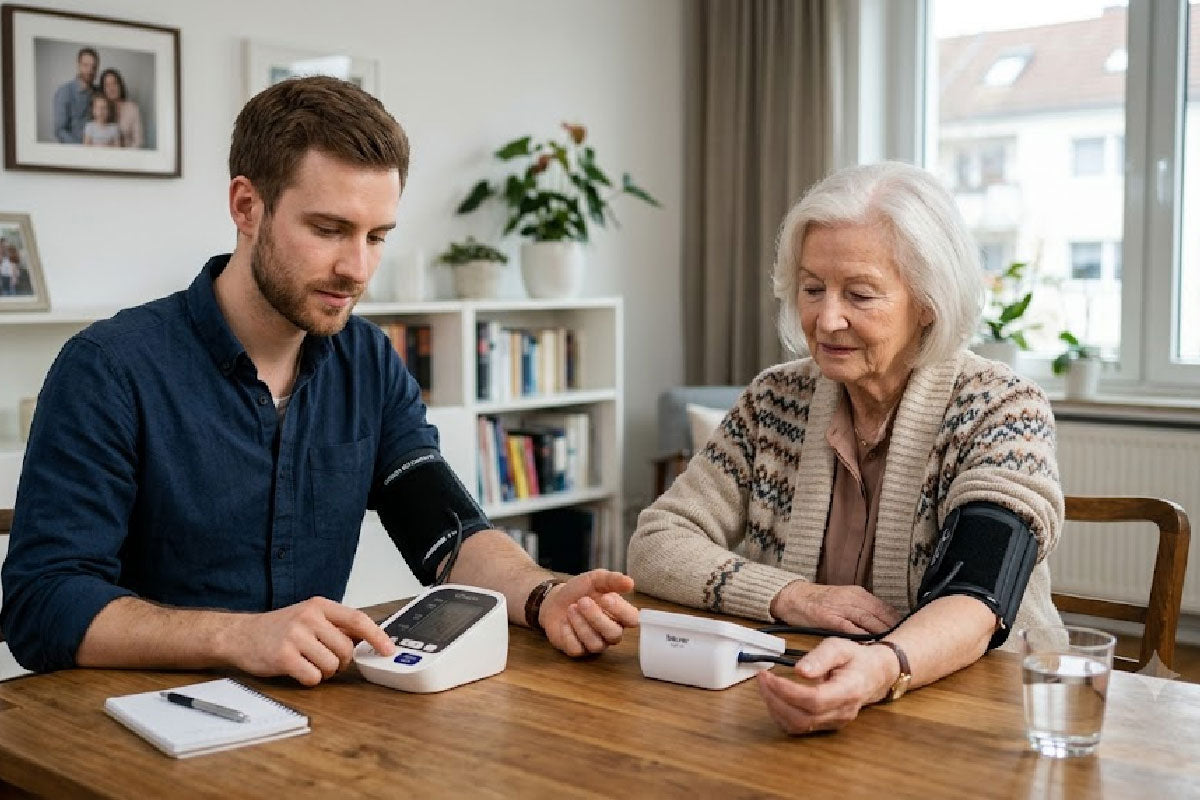
Preparation affects the result as much as the device does. For at least 30 minutes before measuring, avoid smoking, caffeine, and exercise. Empty your bladder, then sit quietly for five minutes with your back supported, feet flat on the floor, and legs uncrossed. Place the cuff on bare skin and support the arm so the middle of the cuff sits at heart level. Stay still and silent throughout.
Record both readings — and nothing extra
Always take a second reading one minute after the first and record both. Small differences between the two are expected. Do not keep measuring until a preferred number appears — that biases the record. Use the morning and bedtime schedule your clinician recommends, and change medication only under professional guidance.
Build context, then review the series
Brief contextual notes add value over time. Disrupted sleep, travel, unusual stress, illness, or recent exercise may explain an outlier. These notes help frame questions for your care team; they cannot establish cause and effect on their own. When you review the series, look at the average and the direction of change rather than any single value, and share the complete record at your next appointment.
Hilo Core keeps this workflow in one system. The cuff supplies scheduled point-in-time readings, and the app presents them alongside the separate Hilo Core Band’s wellness record so the source of each type of information remains visible.
WHEN A VERY HIGH READING NEEDS URGENT ACTION
If your upper-arm cuff shows a reading higher than 180 systolic and/or 120 diastolic, wait at least one minute and measure again.
If the second reading is just as high and you have chest pain, shortness of breath, back pain, numbness, weakness, a change in vision, difficulty speaking, or another new concerning symptom, call 911.
If you do not have symptoms but the reading remains that high, contact your health care professional promptly.
Follow the American Heart Association severe-hypertension guidance.
Do not change medication based on a single reading unless a qualified clinician tells you to.
A single reading is most useful within a well-taken series
A very high reading or a reading accompanied by symptoms can require prompt action. For routine assessment, repeated measurements reveal the average and show whether an unusual value persists. A structured home measurement series and ABPM add information that an office reading cannot provide, each for a defined purpose.
Hilo Core includes the cuff needed for point-in-time readings and the Hilo Core Band and app that extend the record across days and weeks within the wellness experience. Users can arrive at a health conversation with a better organized record and fewer gaps between occasional checks. For a broader view of why blood pressure patterns matter beyond a single number, see the full guide.
See how Hilo Core connects cuff readings with longer-term patterns
Build a Blood Pressure Record That Tells the Full Story
Hilo Core pairs a validated upper-arm cuff for point-in-time reference readings with the Hilo Core Band and app — extending your record across days and weeks so you can see whether a change persists. Available in the US for US$239.98 for the first year (US$89.99 hardware + US$149.99 annual subscription).
Get Hilo CoreDisclaimer: Hilo Core is a wellness product. It is not intended to diagnose, treat, cure, or prevent any disease. It is not intended to measure blood pressure for medical purposes. This article is for general informational purposes only and does not constitute medical advice. Individual health decisions should be made in consultation with a qualified healthcare professional. Hilo Core is not recommended during pregnancy or for individuals with certain cardiac implants or pre-existing conditions. Please consult your healthcare provider before use.
Frequently Asked Questions
Is one blood pressure reading a day useful?
A daily reading can be useful when it is part of a clinician-directed plan and taken at a consistent time under standardized conditions. The daily reading contributes to the series. It should not be used alone to confirm hypertension or judge a treatment change.
Should I record both readings if they differ?
Yes. Record both and follow the planned number of measurements. Taking extra readings until a preferred number appears can bias the record. Small differences are expected, and your health care professional may average the pair or review the full series.
Why is the second reading often lower?
Many people relax further after the first cuff inflation. Small changes in breathing, posture, arm position, cuff placement, or conversation can also affect the result. Paired readings reduce the influence of one unusual measurement.
When should I ask about 24-hour ABPM?
ABPM may be considered when office and home readings disagree, white-coat or masked hypertension is suspected, nighttime pressure is clinically important, or a clinician needs a full 24-hour profile. ABPM is ordered and interpreted through clinical care.
Sources
- D.W. Jones; K.C. Ferdinand; S.J. Taler et al. (2025). 2025 AHA/ACC/AANP/AAPA/ABC/ACCP/ACPM/AGS/AMA/ASPC/NMA/PCNA/SGIM guideline for the prevention, detection, evaluation, and management of high blood pressure in adults. Circulation, 152(11), e114–e218. https://doi.org/10.1161/CIR.0000000000001356. 2025 AHA/ACC High Blood Pressure Guideline
- American Heart Association. (Last reviewed August 14, 2025). Home Blood Pressure Monitoring. (Accessed July 2026). AHA home blood pressure monitoring guidance
- American Heart Association. (Last reviewed August 14, 2025). When To Call 911 About High Blood Pressure. (Accessed July 2026). AHA emergency blood pressure guidance
- U.S. Preventive Services Task Force. (April 27, 2021). Hypertension in Adults: Screening. Final Recommendation Statement. (Accessed July 2026). USPSTF hypertension screening recommendation
- P. Muntner; D. Shimbo; R.M. Carey et al. (2019). Measurement of blood pressure in humans: a scientific statement from the American Heart Association. Hypertension, 73(5), e35–e66. https://doi.org/10.1161/HYP.0000000000000087. AHA scientific statement on blood pressure measurement
- D. Shimbo; N.T. Artinian; J.N. Basile et al. (2020). Self-measured blood pressure monitoring at home: a joint policy statement from the American Heart Association and American Medical Association. Circulation, 142(4), e42–e63. https://doi.org/10.1161/CIR.0000000000000803. AHA/AMA home measurement policy statement
- W.Y. Yang; J.D. Melgarejo; L. Thijs et al. (2019). Association of office and ambulatory blood pressure with mortality and cardiovascular outcomes. JAMA, 322(5), 409–420. https://doi.org/10.1001/jama.2019.9811. JAMA analysis of office and ambulatory blood pressure
- J.B. Cohen; R.L. Byfield; S.T. Hardy et al. (2026). Cuffless devices for the measurement of blood pressure: a scientific statement from the American Heart Association. Hypertension, 83(3), 876–886. https://doi.org/10.1161/HYP.0000000000000254. AHA scientific statement on cuffless blood pressure devices
- J. Alexandre; K. Tan; T.P. Almeida et al. (2023). Validation of the Aktiia blood pressure cuff for clinical use according to the ANSI/AAMI/ISO 81060-2:2013 protocol. Blood Press Monit, 28(2), 109–112. https://doi.org/10.1097/MBP.0000000000000639. Peer-reviewed upper-arm cuff validation study
Read more
You check your blood pressure — but what does the number actually mean for your age? Normal ranges shift with every decade of life. Whether you’re curious about healthy values at 60, 70, or 80, or ...

Blood pressure usually decreases during sleep, and a modest nighttime dip is expected and healthy. What deserves attention is a dip that never happens, or a nighttime number that stays high while t...
Blood pressure moves through the day, so when you check changes what a reading can tell you and your doctor. Learn the best time to measure, how to prepare for each reading, and why the morning num...