

Hilo Core vs. Omron: blood pressure compared
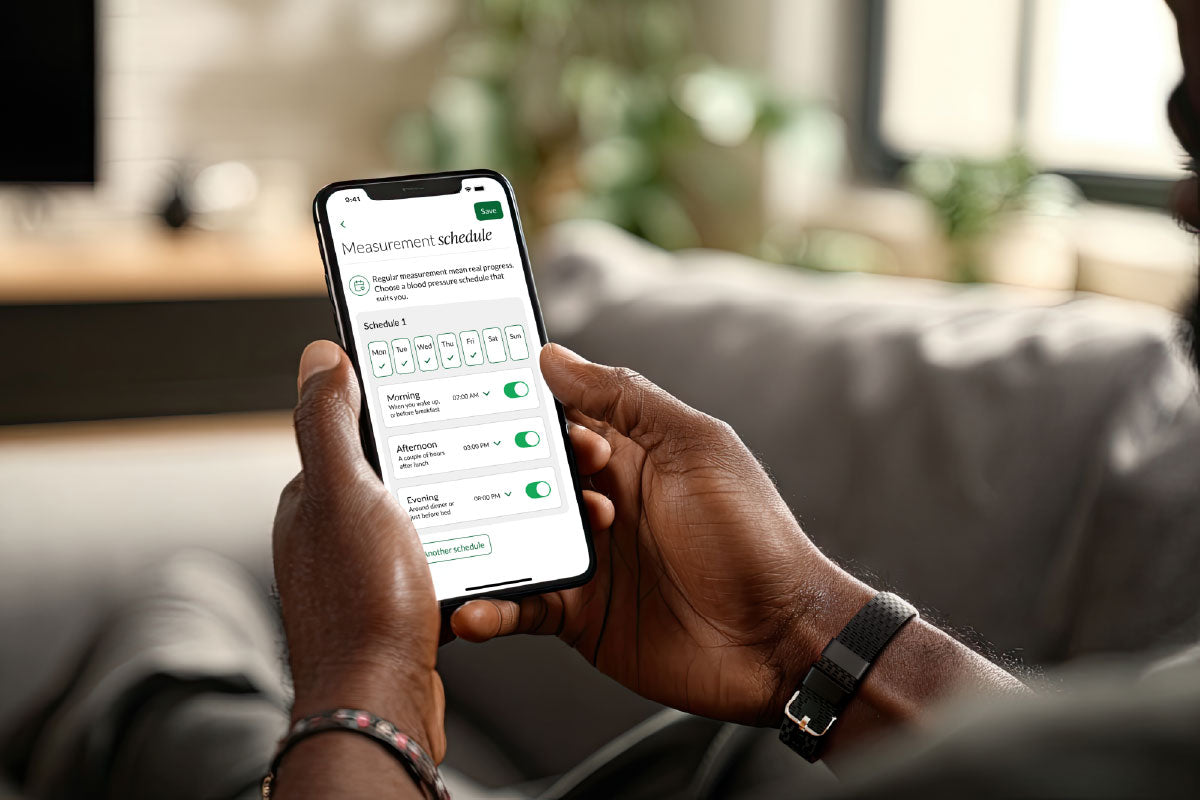
Hilo Core and Omron start from the same foundation: a validated upper-arm cuff. What each system builds around that cuff is where they differ. That difference shapes what each system is for. Omron gives you a capable, standalone home measurement device. Hilo Core builds an integrated experience around that same cuff-first foundation: the validated reading stays at the center, and the band extends the view across days and weeks.
Read how Hilo Core works and why each component has a defined role.
Key facts
- Both start with a validated upper-arm cuff: Hilo Core includes a peer-reviewed validated cuff as the system’s point-in-time reference. A validated Omron model provides the same kind of reading from a standalone device.
- Hilo Core adds a cuffless wellness band: Between active cuff sessions, the band and app show directional patterns across days and weeks, labeled separately from the cuff reference readings.
- The cuff is FDA-cleared; the band is a wellness product: In the U.S. market, Hilo Core’s upper-arm cuff holds FDA clearance as a medical device, while the cuffless band and app launch as a consumer wellness product for awareness and long-term patterns.
- Cuffless trends are not a substitute for cuff readings: The 2025 AHA/ACC Guideline advises against relying on cuffless devices alone for diagnosis or treatment decisions, and the AHA scientific statement on cuffless blood pressure devices reviews the evidence on calibration and real-world performance. Hilo Core’s band stays within the U.S. general-wellness framework.
- Hilo Core is a system; Omron is a monitor: For people who want the cuff, cuffless band, and app designed as one workflow, Hilo Core brings all three into one integrated experience. Explore Hilo Core.
A validated upper-arm cuff remains the standard at home
The 2025 AHA/ACC High Blood Pressure Guideline emphasizes validated devices, appropriate cuff size, standardized technique, repeated readings, and averages. The AHA statement on accurate blood-pressure measurement provides detailed guidance on preparation, posture, cuff placement, and measurement quality. Hilo’s guide on how to measure blood pressure correctly applies the same standards to a home routine.
Hilo Core includes an upper-arm cuff because the system begins with that standard. The cuff supplies the point-in-time reference measurement. In the U.S. market, the Hilo Core cuff holds FDA clearance as a medical device, while the cuffless band launches as a consumer wellness product (Android Headlines). The wearable layer adds longitudinal context without changing the meaning of the cuff reading or asking the band to stand in for it.
Hilo Core vs. Omron at a glance
The comparison comes down to three questions: what each system measures and how that measurement is validated, what it records between active readings, and how its software supports the user.
Here is how Hilo Core and Omron compare across the key blood-pressure dimensions:
| Comparison point | Hilo Core | Omron 10 Series (BP7465) |
|---|---|---|
| Primary job | A blood-pressure-focused system that combines a cuff reference reading with a longer cuffless wellness record. | Point-in-time upper-arm readings with added features such as averaging and memory. |
| What is included | Validated upper-arm cuff, cuffless band, and Hilo app. | A monitor and a preformed upper-arm cuff. |
| Cuff reading | The validated cuff supplies the point-in-time reference reading inside the Hilo system. | The upper-arm cuff supplies a measurement. |
| Record over time | The cuffless band and app add patterns across days and weeks between active cuff sessions. | Measurement history is built only from the cuff measurements the user starts manually. |
| App experience | Organized around blood pressure, with cuff readings and cuffless wellness outputs identified by source. | Stores synced readings, graphs trends from cuff sessions, and supports sharing. Features depend on the model and app version. |
| Validation evidence | Cuff validation is published under the Aktiia device name in Hilo’s product lineage. Optical studies are a separate body of evidence. | The model appears on the U.S. Blood Pressure Validated Device Listing. |
| Best fit | People who want an included reference cuff and a longer BP-focused view in one system. | People who mainly want scheduled or occasional home cuff readings and a conventional monitor. |
Why the included validated cuff is a system advantage
Validation is model-specific. A brand name can cover devices with different algorithms, cuffs, intended populations, and evidence. The exact device matters.
A 2022 JAMA analysis of 3,411 marketed blood pressure devices found that 19.9% were validated or equivalent to a validated model; 76.3% had no published validation evidence. A 2023 JAMA study of the top-selling Amazon lists in 10 countries followed those lists for one year and found a median 79% of upper-arm devices were not found on the validation lists used by the investigators.
Those studies did not prove that every unlisted device was inaccurate. They show why a retail listing, a price, or a high star rating cannot substitute for published validation evidence.
Hilo Core removes one purchasing decision. The reference cuff is already part of the kit and the app workflow, so users do not have to select a separate monitor or build a connection across unrelated products. The included cuff still has to fit the arm and be used according to the setup instructions.
The validation evidence for the upper-arm cuff used in Hilo’s product lineage was published under the Aktiia device name. In the peer-reviewed cuff validation study, three trained observers compared the oscillometric device with mercury double auscultation under the ANSI/AAMI/ISO 81060-2:2013 protocol. The mean difference was 1.3 mm Hg for systolic pressure (SD 7.11) and -0.2 mm Hg for diastolic pressure (SD 5.46), and the cuff met the protocol criteria. The U.S. validated-device entry for Omron BP7465 likewise confirms validation for that exact Omron model.
A validated device still requires a cuff that fits the arm and a user who follows the instructions. Including the reference cuff and its setup inside Hilo gives the system a consistent starting point.
What Hilo adds between active cuff readings
A connected Omron monitor can store and organize readings digitally. The Omron BP7465 product page lists averaging, two-user memory, Bluetooth connectivity, and app graphs. That history is built from the cuff sessions the user starts.
The clinical reference for around-the-clock blood pressure data is 24-hour ambulatory blood pressure monitoring (ABPM): a wearable cuff that records automatically through the day and night. ABPM is a diagnostic test that a physician orders (CMS decision memo); access runs through a clinical setting. Hilo Core’s cuffless band gives home users a wellness option for the periods between cuff sessions: calibrated by the included cuff, it captures reference measurements through the day and night and turns them into patterns across days and weeks.
Hilo adds a second source of information for the periods between those sessions. The cuffless band supports a longer wellness record across ordinary days and nights, and the app can show whether a shift appears briefly or continues across several days. Users can view changes alongside routine information that may be worth noticing, including sleep, movement, or changes in daily habits. These outputs support observation and reflection. They do not establish cause and effect or direct treatment.
Hilo’s interface stays focused on blood pressure. The main record consists of cuff readings, longer-term trends, and everyday context. Training-readiness and strain scores sit outside the experience, so users do not have to sort through a broad performance dashboard to reach the information they bought the product to see.
What the Hilo research record establishes
Research claims need a defined scope. Hilo’s broader scientific program spans more than 20 years of research in optical blood pressure technology.
The record includes a one-month validation study of the earlier Aktiia bracelet, an evaluation across common body positions, and a 2024 analysis of 2.3 million readings from 5,189 European home users.
These publications concern earlier Aktiia medical-device configurations. Hilo Core’s U.S. cuffless experience has a general-wellness role. The studies document the research program’s work on calibration, posture, signal acceptance, and longitudinal data. They should not be read as clinical validation of Hilo Core or as evidence that its band supplies continuous exact blood pressure. Hilo’s article on the accuracy of cuffless blood pressure monitoring covers the cuffless evidence in more depth.
The distinction also matters when comparing a cuff with a wearable. A cuff validation study tests whether a defined upper-arm device agrees with a reference method under a validation protocol. Cuffless studies examine different devices, algorithms, reference methods, and use conditions. Hilo presents those evidence streams separately.
Hilo vs. Omron: which fits your use case?
Hilo Core may be the better fit when:
- Blood pressure is the main reason for the purchase.
- The user wants the cuff, cuffless band, and app designed as one workflow.
- Seeing whether a change persists across days and weeks matters.
- A blood-pressure-focused app is preferable to a general fitness dashboard.
Hilo Core includes the upper-arm cuff. A separate Omron monitor is unnecessary, and third-party cuffs should not be assumed to exchange data with Hilo or substitute for the included cuff.
Omron is likely the better fit when the user mainly wants scheduled or occasional cuff readings and a conventional standalone monitor, without the added context of a wellness band or a blood-pressure-focused app.
The practical difference
Omron is a capable connected home monitor. It supplies upper-arm readings, memory, and measurement history based on the measurements a user chooses to take.
Hilo Core keeps the validated cuff at the center of the system and extends the experience between active readings. Its cuffless band and app are designed to make longer-term patterns easier to see while preserving the cuff as the reference.
The purchase decision is about scope. Hilo Core costs US$239.98 (US$89.99 hardware + US$149.99 annual subscription); after the first year, the subscription continues at US$149.99 per year and can be cancelled anytime. For a reading and a conventional history, Omron may be enough. For a validated reference cuff and a longer blood-pressure-focused view in one system, Hilo Core brings those elements together in a single workflow.
WHEN A VERY HIGH READING NEEDS URGENT ACTION
If an upper-arm cuff reading is higher than 180 systolic and/or 120 diastolic, wait at least one minute and measure again.
If the second reading is just as high and you have chest pain, shortness of breath, back pain, numbness, weakness, a change in vision, difficulty speaking, or another new concerning symptom, call 911.
If you do not have symptoms but the reading remains that high, contact your health care professional promptly.
Follow the American Heart Association severe-hypertension guidance.
Do not change medication based on a single reading unless a qualified clinician tells you to.
One system. Validated cuff, cuffless band, and a BP-focused app.
Hilo Core includes the validated upper-arm cuff that supplies your point-in-time reference, plus a cuffless band and app that keep blood pressure at the center of the experience.
Get Hilo CoreFAQ
What is an alternative to an Omron home blood pressure monitor?
For people who want more than on-demand cuff readings, Hilo Core pairs a validated upper-arm cuff with a cuffless band and app that show blood pressure patterns across days and weeks. The clinical route to around-the-clock data is 24-hour ambulatory blood pressure monitoring, which a physician orders. Hilo Core’s band serves a wellness role: it shows trends for awareness, and the cuff remains the reference.
How does Hilo Core differ from an Omron monitor?
Hilo’s included cuff and a validated Omron model can both provide point-in-time upper-arm readings when the correct cuff size and technique are used. Hilo differs by connecting its cuff with a cuffless band and app for longer-term patterns; for people who want more than a reading, that broader view is what Hilo Core adds.
Does Hilo Core include an upper-arm cuff?
Yes. The validated upper-arm cuff is included and provides the point-in-time reference reading within the Hilo Core system. A separate Omron monitor is not required.
Does the Hilo Core band provide continuous exact blood pressure?
No. The cuff supplies the point-in-time reference reading. The cuffless band and app support awareness of longer-term wellness patterns and everyday context; they are not a substitute for cuff-based measurement.
Can I use a third-party cuff such as Omron with Hilo Core?
Hilo Core is supplied with its own upper-arm cuff and app workflow. A third-party cuff should not be assumed to connect, share data, or operate interchangeably unless Hilo explicitly supports that exact device.
Disclaimer: Hilo Core is a wellness product. It is not intended to diagnose, treat, cure, or prevent any disease. It is not intended to measure blood pressure for medical purposes. This article is for general informational purposes only and does not constitute medical advice. Individual health decisions should be made in consultation with a qualified healthcare professional. Hilo Core is not recommended during pregnancy or for individuals with certain cardiac implants or pre-existing conditions. Please consult your healthcare provider before use.
Sources
- J. B. Cohen; R. L. Byfield; S. T. Hardy et al. (2026). Cuffless devices for the measurement of blood pressure: a scientific statement from the American Heart Association. Hypertension, 83, 876–886. https://doi.org/10.1161/HYP.0000000000000254
- D. W. Jones; K. C. Ferdinand; S. J. Taler et al. (2025). 2025 AHA/ACC/AANP/AAPA/ABC/ACCP/ACPM/AGS/AMA/ASPC/NMA/PCNA/SGIM guideline for the prevention, detection, evaluation, and management of high blood pressure in adults. Circulation, 152, e114–e218. https://doi.org/10.1161/CIR.0000000000001356
- N. D. L. Fisher; T. P. Almeida; D. Perruchoud et al. (2024). Optimizing time-in-target-range assessment for blood pressure: insights from a large-scale study with continual cuffless monitoring. Frontiers in Medicine, 11, 1396962. https://doi.org/10.3389/fmed.2024.1396962
- J. Alexandre; K. Tan; T. P. Almeida et al. (2023). Validation of the Aktiia blood pressure cuff for clinical use according to the ANSI/AAMI/ISO 81060-2:2013 protocol. Blood Pressure Monitoring, 28(2), 109–112. https://doi.org/10.1097/MBP.0000000000000639
- D. S. Picone; N. Chapman; M. G. Schultz et al. (2023). Availability, cost, and consumer ratings of popular nonvalidated vs validated blood pressure-measuring devices sold online in 10 countries. JAMA, 329(17), 1514–1516. https://doi.org/10.1001/jama.2023.2661
- D. S. Picone; N. R. C. Campbell; A. E. Schutte et al. (2022). Validation status of blood pressure measuring devices sold globally. JAMA, 327(7), 680–681. https://doi.org/10.1001/jama.2021.24464
- A. Vybornova; E. Polychronopoulou; A. Wurzner-Ghajarzadeh et al. (2021). Blood pressure from the optical Aktiia Bracelet: a 1-month validation study using an extended ISO 81060-2 protocol adapted for a cuffless wrist device. Blood Pressure Monitoring, 26(4), 305–311. https://doi.org/10.1097/MBP.0000000000000531
- J. Sola; A. Vybornova; S. Fallet et al. (2021). Validation of the optical Aktiia bracelet in different body positions for the persistent monitoring of blood pressure. Scientific Reports, 11, 20644. https://doi.org/10.1038/s41598-021-99294-w
- P. Muntner; D. Shimbo; R. M. Carey et al. (2019). Measurement of blood pressure in humans: a scientific statement from the American Heart Association. Hypertension, 73(5), e35–e66. https://doi.org/10.1161/HYP.0000000000000087
- General Wellness: Policy for Low Risk Devices. Guidance for Industry and Food and Drug Administration Staff. U.S. Food and Drug Administration. https://www.fda.gov/regulatory-information/search-fda-guidance-documents/general-wellness-policy-low-risk-devices (Accessed October 2026)
- Ambulatory Blood Pressure Monitoring (ABPM) (CAG-00067R2), Decision Memo. Centers for Medicare & Medicaid Services. https://www.cms.gov/medicare-coverage-database/view/ncacal-decision-memo.aspx?proposed=N&NCAId=294 (Accessed October 2026)
- Hilo Core Brings Continuous BP Tracking to US. Android Headlines. https://www.androidheadlines.com/2026/07/hilo-core-continuous-blood-pressure-wearable-us-launch.html (Accessed October 2026)
- When to Call 911 for High Blood Pressure. American Heart Association. https://www.heart.org/en/health-topics/high-blood-pressure/understanding-blood-pressure-readings/when-to-call-911-for-high-blood-pressure (Accessed October 2026)
- 10 Series Upper Arm Blood Pressure Monitor (BP7465). Omron Healthcare. https://omronhealthcare.com/products/10-series-upper-arm-blood-pressure-monitor-bp7465 (Accessed October 2026)
- Omron 10 Series Upper Arm Blood Pressure Monitor. ValidateBP.org. https://www.validatebp.org/device/10-series-upper-arm-blood-pressure-monitor (Accessed October 2026)
Read more

Hilo Core brings a focused cuff, band, and app system to the U.S. WIRED rated an earlier medical Hilo system 8/10. The Independent wore that system for two months and praised its comfort, pared-bac...

Can you wear Hilo Core day and night? Yes. Hilo Core is designed for day-and-night wear, with brief breaks for charging, cleaning, skin care, and app-guided cuff sessions. The screen-free band and ...

When you first set up Hilo Core — or when the app prompts you after 30 days — calibration is what connects the band’s optical readings to your physiology. Hilo Core, formerly developed under the Ak...