

What does high blood pressure in the morning mean?

You check your blood pressure first thing in the morning, before coffee, before the day gets going, and the number is noticeably higher than last night's reading. Nothing obvious changed. So what does high blood pressure in the morning actually mean? For most people, the answer is reassuring: blood pressure naturally rises in the early-morning-hours as part of the body's daily rhythm (Mayo Clinic). Here is what is normal, what doctors mean by a morning surge, and when a morning number is worth mentioning to your doctor.
Key facts
- A morning rise is common: blood pressure usually starts climbing a few hours before you wake and peaks around midday, as part of the body's daily rhythm.
- Two distinct patterns: doctors separate an ordinary morning rise from a clinically defined "morning surge" and from "morning hypertension," two related but distinct terms (K. Kario; T. G. Pickering; Y. Umeda et al., 2003; X. Liu; T. Zhang; A. Qin et al., 2021).
- Why doctors look closely: an exaggerated morning surge has been linked to higher stroke risk in a study of older adults with hypertension, so one reading is not the whole story (K. Kario; T. G. Pickering; Y. Umeda et al., 2003).
- Your own trends: Hilo Core can help you see your morning blood pressure trends over time and bring that context to your doctor.
Why your blood pressure usually climbs in the morning
Blood pressure follows a daily rhythm that tracks the sleep-wake cycle. According to the Mayo Clinic, it usually starts to rise a few hours before a person wakes up, continues to rise during the day, and peaks around midday, then tends to fall during the late afternoon and evening. It is usually lower at night while sleeping. The American Heart Association's scientific statement on blood pressure measurement describes the same pattern from the nighttime side: blood pressure normally decreases during sleep, a pattern called nocturnal dipping, followed by a rapid rise in blood pressure when people awaken.

As the body transitions from sleep to waking, the "activate" signals of the sympathetic nervous system ramp up. A review describes these changes in nervous system activity as what appears to be the key factor behind the rapid increase in blood pressure known as the morning blood pressure surge, with the release of stress hormones, including cortisol, as a potential mechanism (G. Bilo; A. Grillo; V. Guida et al., 2018).
For most people, this rise is ordinary physiology and, by itself, not a warning sign.
"Morning surge" and "morning hypertension": two different ideas
Doctors and researchers use two related terms for morning blood pressure, and they measure different things. The morning blood pressure surge is a measure of change: one long-term study calculated it as the difference between your average systolic reading in the first two hours after waking and the reading around your overnight low (K. Kario; T. G. Pickering; Y. Umeda et al., 2003).
Morning hypertension, by contrast, is a measure of an absolute value: an elevated average reading within the first two hours after waking (X. Liu; T. Zhang; A. Qin et al., 2021).
Both ideas connect to the nighttime side of the same rhythm. When blood pressure falls by less than 10% from awake to asleep levels, the pattern is called nondipping. Ambulatory and home blood pressure monitoring have driven greater recognition of nighttime high blood pressure and abnormal dipping patterns, which a single office reading does not capture (A. Tang; E. Yang; J. E. Ebinger, 2024).
These time-of-day patterns are separate from masked hypertension, which concerns where blood pressure is measured and is covered below.
Why high blood pressure in the morning matters for heart and stroke risk
According to a review, the morning hours have the highest incidence of major cardiovascular events, including heart attack and stroke (G. Bilo; A. Grillo; V. Guida et al., 2018). That observation is one reason the early-morning window gets clinical attention.
One prospective study illustrates why. Among 519 older adults with hypertension followed for an average of 41 months, those in the top decile of morning surge, 55 mm Hg or higher, had a higher stroke incidence, 19% versus 7.3%, than the rest of the group. When participants were matched for age and 24-hour blood pressure, the relative risk of stroke in the high-surge group remained significantly higher, at 2.7 (K. Kario; T. G. Pickering; Y. Umeda et al., 2003). The study population was older adults with hypertension, so these numbers describe that group.
That is why doctors treat an exaggerated morning surge as a distinct data point worth discussing, and why an ordinary morning reading is not, by itself, a reason to feel alarmed.
What can be behind high blood pressure in the morning
Several factors can push morning numbers higher than the ordinary rise, and one measurement pattern can make home readings look higher than office readings. Each is distinct, and most become visible only when you look at readings across more than one morning.
A blunted overnight dip. With nondipping, blood pressure falls by less than 10% from awake to asleep levels (P. Muntner; D. Shimbo; R. M. Carey et al., 2019). The American Heart Association notes that higher blood pressure during sleep is associated with increased cardiovascular risk, even after accounting for awake blood pressure.
Obstructive sleep apnea. Sleep apnea is a recognized cause of secondary hypertension, meaning high blood pressure that stems from another condition: apnea episodes produce surges in systolic and diastolic pressure that keep average blood pressure levels elevated at night, and in many patients blood pressure remains elevated during the daytime (J. M. Dopp; K. J. Reichmuth; B. J. Morgan, 2007). The 2025 AHA/ACC hypertension guideline lists these cues as indications for further sleep apnea testing:
- Snoring
- Choking or gasping during sleep
- Daytime sleepiness
The guideline also lists loss of the normal nighttime blood pressure fall among the associated exam findings. Screening runs through validated questionnaires and overnight oximetry, with polysomnography or home sleep apnea testing as confirmatory steps a doctor orders. For people with obstructive sleep apnea, CPAP can modestly lower blood pressure; the guideline cites reductions of 2 to 5 mm Hg.
Medication coverage. For people already treated for high blood pressure, some antihypertensive medications may not fully cover the early-morning hours for every patient: a Japanese study associated this pattern with an insufficient duration of action of widely used antihypertensive drugs in Japan from the 1980s to 1990s (K. Chonan; J. Hashimoto; T. Ohkubo et al., 2002). This effect is well known and worth discussing with a physician. No one should adjust, re-time, or stop their medication without physician consultation, since doing so can cause health damage.
Masked hypertension. When morning readings at home run high while the doctor's office reading looks fine, the pattern can reflect masked hypertension: blood pressure below the hypertension threshold in the office but high outside it. Masked hypertension is a measurement-context pattern, not a cause of blood pressure fluctuation, and it is one reason doctors sometimes recommend checking blood pressure outside the office.
Getting a morning reading that actually reflects your blood pressure
The American Heart Association's guidance for home readings lists these steps:
- Empty your bladder before measuring.
- Sit quietly for at least five minutes before taking a reading, with no talking or phone.
- Take at least two readings, one minute apart.
- Sit with your back straight and supported, feet flat on the floor, arm resting on a flat surface at heart level.
- Avoid exercise, smoking, or caffeine in the 30 minutes beforehand.
- Measure at the same time each day, and ask your clinician how often you should measure.
For a structured routine, AHA's home blood pressure log specifies two readings one minute apart in the morning before food or medication, and two at bedtime, for at least three days and preferably seven.
A single reading captures your blood pressure in one moment: it shows you a value, but not the pattern behind it. On its own, one morning reading cannot tell you whether you are seeing an ordinary rise, a real surge, or nothing unusual at all; that takes readings from several mornings.
Seeing your morning pattern over time
Hilo Core is designed to help you understand how your daily habits relate to your blood pressure patterns over time. Validated cuff readings anchor the system, and the band and app add a longer-term view. It can help you see your morning blood pressure trends over time and bring that context to your doctor.
Seeing how your trends develop across many mornings, with sleep and activity alongside them, adds the context a single reading lacks.
Making sense of high blood pressure in the morning
A rise in blood pressure in the early-morning hours is usually part of the body's daily rhythm (Mayo Clinic). An exaggerated surge, or a consistently high reading in the early-morning window, is a distinct and studied pattern worth a conversation with your doctor (K. Kario; T. G. Pickering; Y. Umeda et al., 2003; X. Liu; T. Zhang; A. Qin et al., 2021). One reading is a data point, and the pattern across many mornings shows the fuller picture. Bringing that pattern to your next appointment gives the conversation more to work with.
See your patterns, not just a number
Hilo Core pairs a validated cuff with everyday trend data from your band and app, so you and your doctor have more context than one reading can give.
Get Hilo CoreFAQ
Is it normal for blood pressure to be higher in the morning?
Usually, yes. Blood pressure follows a daily rhythm: it usually starts to rise a few hours before waking, climbs into midday, and is usually lower at night while sleeping. This usual morning rise is distinct from an exaggerated morning surge, which is a separately studied clinical pattern (K. Kario; T. G. Pickering; Y. Umeda et al., 2003).
What is a "morning blood pressure surge," and why do doctors pay attention to it?
The surge is a measure of change. One long-term study calculated it as the difference between your average systolic reading in the first two hours after waking and the reading around your overnight low (K. Kario; T. G. Pickering; Y. Umeda et al., 2003). Among the older adults with hypertension in that study, those with the largest surges had a higher stroke incidence, a finding that held when participants were matched for age and 24-hour blood pressure (K. Kario; T. G. Pickering; Y. Umeda et al., 2003). It is a pattern worth discussing with your doctor.
Can blood pressure medication cause high readings in the morning?
Some antihypertensive medications may not fully cover the early-morning hours for every patient: a Japanese study (K. Chonan; J. Hashimoto; T. Ohkubo et al., 2002) linked this pattern to an insufficient duration of action of widely used antihypertensive drugs in Japan from the 1980s to 1990s. This effect is well known and worth discussing with a physician. Medication should never be adjusted, re-timed, or stopped without physician consultation, since doing so can cause health damage.
Why might my morning blood pressure look high at home when my doctor's office reading is normal?
That pattern can reflect masked hypertension: blood pressure below the hypertension threshold in the office but high outside it. It reflects where blood pressure is measured, and it is one reason doctors sometimes recommend checking blood pressure outside the office.
Disclaimer: Hilo Core is a wellness product. It is not intended to diagnose, treat, cure, or prevent any disease. It is not intended to measure blood pressure for medical purposes. This article is for general informational purposes only and does not constitute medical advice. Individual health decisions should be made in consultation with a qualified healthcare professional. Hilo Core is not recommended during pregnancy or for individuals with certain cardiac implants or pre-existing conditions. Please consult your healthcare provider before use.
Sources
- D. W. Jones; K. C. Ferdinand; S. J. Taler et al. (2025). 2025 AHA/ACC/AANP/AAPA/ABC/ACCP/ACPM/AGS/AMA/ASPC/NMA/PCNA/SGIM Guideline for the Prevention, Detection, Evaluation, and Management of High Blood Pressure in Adults: A Report of the American College of Cardiology/American Heart Association Joint Committee on Clinical Practice Guidelines. Hypertension, 82, e212–e316.
https://doi.org/10.1161/HYP.0000000000000249
(Accessed October 2026) - A. Tang; E. Yang; J. E. Ebinger (2024). Non-Dipping Blood Pressure or Nocturnal Hypertension: Does One Matter More? Current Hypertension Reports, 26, 21–30.
https://doi.org/10.1007/s11906-023-01273-1
(Accessed October 2026) - X. Liu; T. Zhang; A. Qin et al. (2021). Association of morning blood pressure surge with chronic kidney disease progression in patients with chronic kidney disease and hypertension. Journal of Clinical Hypertension, 23(10), 1879–1886.
https://doi.org/10.1111/jch.14366
(Accessed October 2026) - P. Muntner; D. Shimbo; R. M. Carey et al. (2019). Measurement of Blood Pressure in Humans: A Scientific Statement From the American Heart Association. Hypertension, 73(5), e35–e66.
https://doi.org/10.1161/HYP.0000000000000087
(Accessed October 2026) - G. Bilo; A. Grillo; V. Guida et al. (2018). Morning blood pressure surge: pathophysiology, clinical relevance and therapeutic aspects. Integrated Blood Pressure Control, 11, 47–56.
https://www.tandfonline.com/doi/full/10.2147/IBPC.S130277
(Accessed October 2026) - J. M. Dopp; K. J. Reichmuth; B. J. Morgan (2007). Obstructive sleep apnea and hypertension: mechanisms, evaluation, and management. Current Hypertension Reports, 9(6), 529–534.
https://pubmed.ncbi.nlm.nih.gov/18367017/
(Accessed October 2026) - K. Kario; T. G. Pickering; Y. Umeda et al. (2003). Morning Surge in Blood Pressure as a Predictor of Silent and Clinical Cerebrovascular Disease in Elderly Hypertensives: A Prospective Study. Circulation, 107(10), 1401–1406.
https://www.ahajournals.org/doi/10.1161/01.cir.0000056521.67546.aa
(Accessed October 2026) - K. Chonan; J. Hashimoto; T. Ohkubo et al. (2002). Insufficient duration of action of antihypertensive drugs mediates high blood pressure in the morning in hypertensive population: the Ohasama study. Clinical and Experimental Hypertension, 24(4), 261–275.
https://doi.org/10.1081/CEH-120004230
(Accessed October 2026) - Blood pressure: Does it have a daily pattern? Mayo Clinic.
https://www.mayoclinic.org/diseases-conditions/high-blood-pressure/expert-answers/blood-pressure/faq-20058115
(Accessed October 2026) - Monitoring Your Blood Pressure at Home. American Heart Association.
https://www.heart.org/en/health-topics/high-blood-pressure/understanding-blood-pressure-readings/monitoring-your-blood-pressure-at-home
(Accessed October 2026) - My Blood Pressure Log. American Heart Association.
https://professional.heart.org/-/media/Files/Health-Topics/High-Blood-Pressure/My-Blood-Pressure-Log.pdf
(Accessed October 2026)
Read more
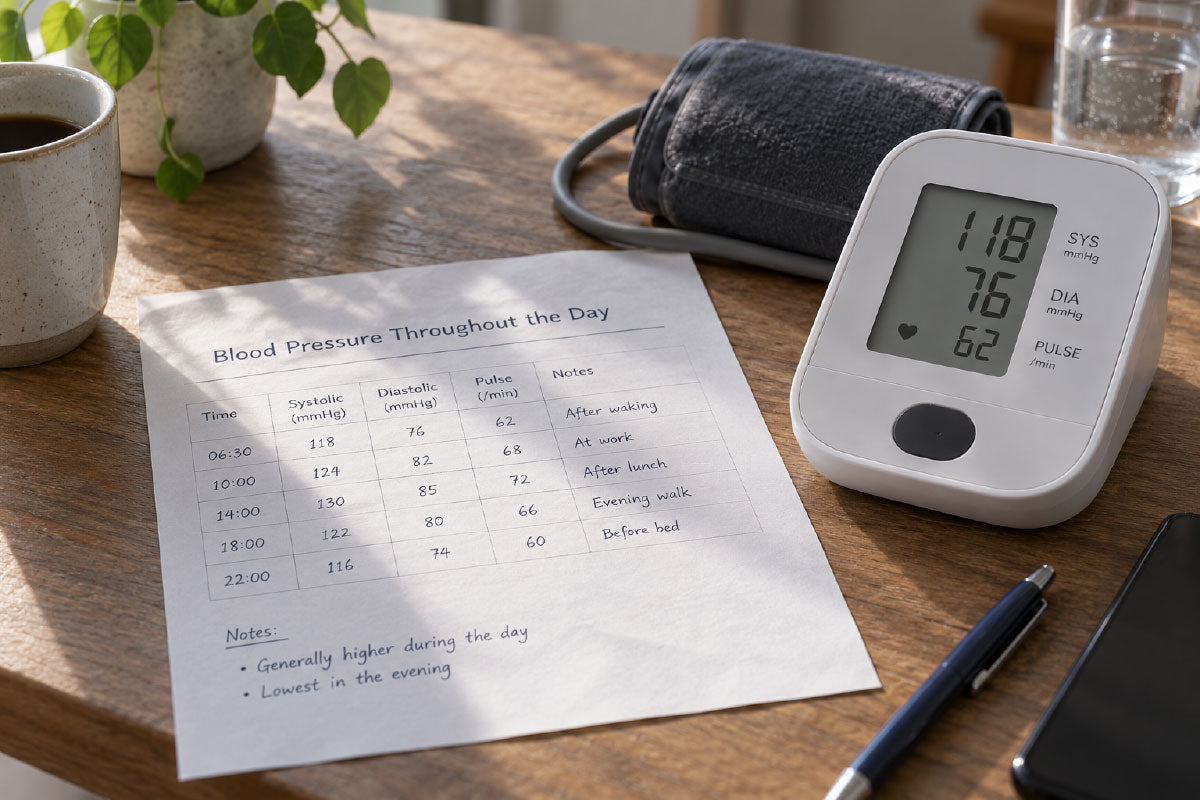
You check your blood pressure in the morning, then again after lunch, and the numbers don't match. That's not a mistake or a broken cuff. Blood pressure changes throughout the day as part of a norm...

Blood pressure changes throughout the day. A morning reading may be accurate for that moment while leaving the surrounding hours unobserved. U.S. guidance therefore relies on repeated, standardized...

As we introduce Hilo to U.S. consumers, we bring blood pressure research dating to 2004, more than 35 patents across our team, clinical studies across several device generations, and regulated-devi...