

How your blood pressure changes throughout the day (and why that’s normal)
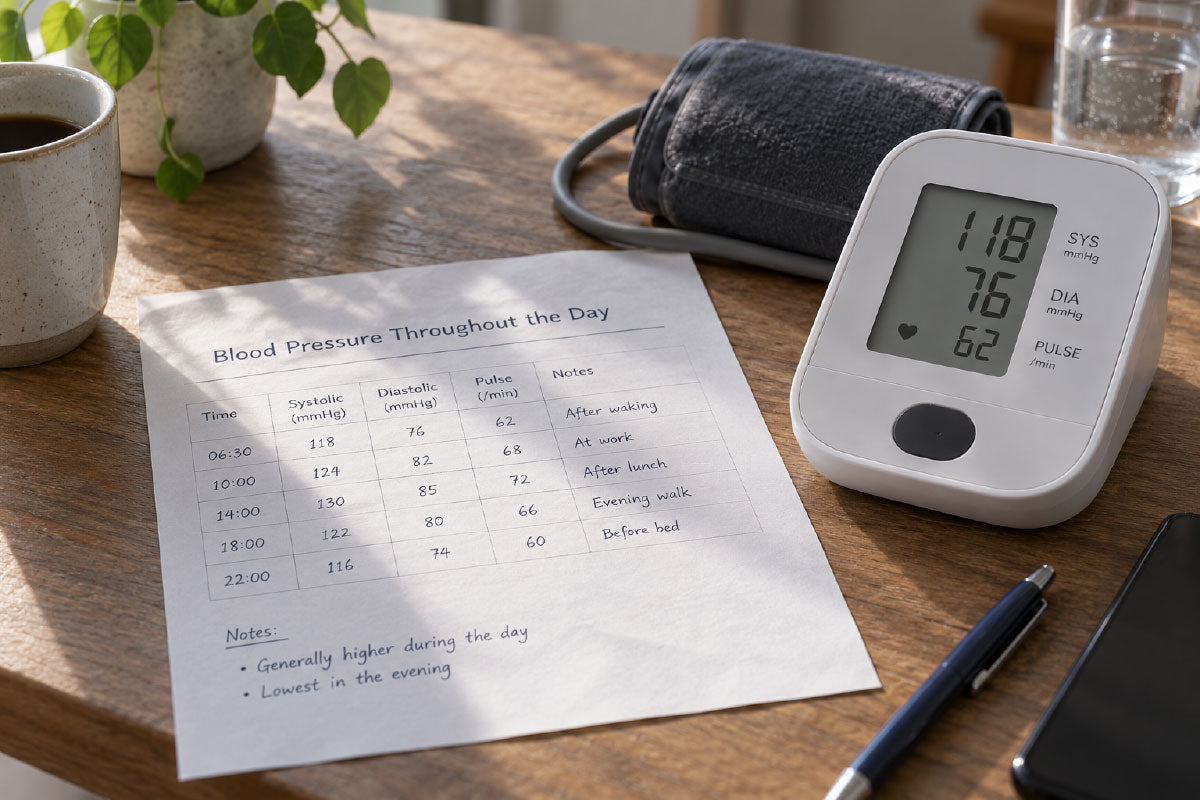
You check your blood pressure in the morning, then again after lunch, and the numbers don’t match. That’s not a mistake or a broken cuff. Blood pressure changes throughout the day as part of a normal daily rhythm, rising before you wake, moving through the day, and settling overnight. A single reading is a real, useful data point, it just captures one moment, not the pattern behind it. Understanding that rhythm, especially what happens to your numbers overnight, helps you read your own results with more context.
Key facts
- Your numbers follow a daily rhythm: blood pressure typically starts rising before you wake, climbs toward a midday peak, then falls through the evening to its lowest point overnight (Mayo Clinic).
- The overnight dip matters most: a healthy pattern includes a drop of at least 10% below your daytime average while you sleep. A pattern that doesn’t dip that way is linked to higher cardiovascular risk over time, independent of your average number (W. C. Birmingham et al., 2023).
- Most daytime swings have simple explanations: activity, stress, poor sleep, and irregular schedules account for the majority of the ups and downs you’ll see in a day. A pattern that never dips at night, or spikes well outside your usual range, is worth a closer look with your doctor.
- Hilo Core helps you see the pattern, not just a moment: it’s built to show how your blood pressure trends across real days and nights, so a single reading stops carrying the whole story on its own.
Why your blood pressure changes throughout the day
Blood pressure follows a predictable daily pattern in most people. It starts to rise a few hours before you wake up, continues climbing through the morning, and reaches a peak around midday. From there it tends to fall through the late afternoon and evening, and it’s lowest of all overnight while you sleep (Mayo Clinic).
This is the default healthy pattern, not something going wrong. It’s also why two readings taken hours apart can legitimately look different even on a completely ordinary day. A single check-in still tells you something real, your number in that moment, it just doesn’t show you where that moment sits inside the larger pattern. That distinction matters more than it sounds: an occasional office or clinic reading only ever captures a narrow slice of a rhythm that’s constantly in motion (A. Tang et al., 2023).
Why the overnight dip is the part that matters most
Of everything that happens across a 24-hour blood pressure rhythm, the overnight drop carries the most clinical weight. In a healthy pattern, blood pressure falls by at least 10% compared to the average during the day, a pattern doctors call nocturnal dipping (W. C. Birmingham et al., 2023).
When that overnight drop doesn’t happen, the pattern is called non-dipping. Research associates blunted nocturnal dipping with higher cardiovascular risk, and some evidence suggests it may be a stronger predictor of that risk than either your daytime or nighttime average on its own (W. C. Birmingham et al., 2023).
Here’s what makes this pattern easy to miss: it’s structurally invisible in a single clinic visit or an occasional spot check. You’d need readings spread across a full day and night, including while you’re asleep, to see whether your own dip is showing up. Longer-term, ambulatory-style tracking is what has driven better recognition of non-dipping and nighttime blood pressure issues in general, patterns a once-a-day reading simply can’t surface (A. Tang et al., 2023).
What causes your blood pressure to change throughout the day
Beyond the baseline rhythm, everyday life adds its own variation. Physical activity raises blood pressure temporarily, and it settles back down once you rest. Stress, whether from a tense meeting or a stressful commute, can do the same. Poor sleep the night before, unusually hot or cold weather, and irregular schedules like shift work are all common, explainable reasons your numbers move around within a day (Mayo Clinic).
Most of this is the system working as intended, not a warning sign. If medication comes up as a factor at all, the right move is general: review your full medication list, including anything over the counter, with your doctor, since some interactions are worth checking (Mayo Clinic). That’s a question for your physician, not a change to make on your own based on an article.
When a swing is worth a closer look
Occasionally, a reading spikes well above someone’s usual range, high enough and often enough that it’s a real trend rather than an off day. That’s a pattern doctors watch for and take seriously, and it’s worth flagging to your physician rather than something to work out on your own at home (Cleveland Clinic).
It’s also worth understanding two terms correctly, because they get confused often. Masked hypertension describes blood pressure that looks normal in a clinic setting but runs higher in daily life, at home, at work, and so on (T. G. Pickering et al., 2007). This is a measurement-context phenomenon, not a fluctuation, the underlying blood pressure isn’t swinging wildly, it’s simply higher in daily life than a single office visit shows.
If a non-dipping or consistently unusual pattern does show up, it’s sometimes tied to an underlying cause worth investigating. The most common one, and the one most often missed, is obstructive sleep apnea. Repeated breathing interruptions during sleep can keep blood pressure elevated overnight and, in many people, into the daytime as well, even when breathing is normal by then (J. M. Dopp et al., 2007). Snoring, feeling tired despite a full night’s sleep, and breathing pauses a partner has noticed are the practical signs worth mentioning to a doctor. Treating sleep apnea, for example with a CPAP machine, has been shown to restore a healthier overnight dipping pattern in many patients (J. M. Dopp et al., 2007). There are rarer underlying causes further down this diagnostic path, but working through them is your doctor’s job once sleep apnea has been ruled out.
Why a single check-in can’t show you this
Put the pieces together and a pattern emerges: the overnight dip, the ordinary daytime swings, the exceptions worth flagging, none of them are visible from one reading taken at one point in time (W. C. Birmingham et al., 2023). A single number tells you where you stood in that moment, but not whether your rhythm includes a healthy overnight dip, or whether a swing you noticed last Tuesday was routine or worth mentioning at your next appointment.
Seeing that fuller picture takes readings spread across real days, woven into your regular routine rather than reserved for an occasional check-in.
Getting the fuller picture
Hilo Core is built around exactly this gap: a wearable band gives you ongoing context on your everyday patterns, including while you sleep, while the included cuff delivers the validated reference readings your doctor relies on. Together, that turns a single number into a fuller picture, one worth bringing to your next appointment.
Your blood pressure tells a story across the day, not in one number
A single blood pressure reading is a real, useful data point, it just covers one moment instead of the pattern behind it. What’s worth a closer look is a pattern: numbers that never seem to dip at night, or spikes that show up again and again outside your usual range. Either way, that’s something to bring up with your doctor, informed by more than one moment in time.
See your blood pressure pattern, not just a number
Hilo Core pairs a wearable band that gives you ongoing context across your everyday routine, including while you sleep, with a validated cuff that provides the reference readings your doctor relies on, so a single check stops being the whole story.
Get Hilo CoreDisclaimer: Hilo Core is a wellness product. It is not intended to diagnose, treat, cure, or prevent any disease. It is not intended to measure blood pressure for medical purposes. This article is for general informational purposes only and does not constitute medical advice. Individual health decisions should be made in consultation with a qualified healthcare professional. Hilo Core is not recommended during pregnancy or for individuals with certain cardiac implants or pre-existing conditions. Please consult your healthcare provider before use.
FAQ
Why does my blood pressure reading change every time I check it during the day?
Blood pressure naturally rises before you wake, climbs toward a midday peak, and falls through the evening into its lowest point overnight (Mayo Clinic). Seeing different numbers at different times of day is expected, it reflects this normal rhythm rather than a problem with your reading or your health.
What is a normal nighttime blood pressure dip, and why does it matter?
A healthy overnight pattern includes a drop of at least 10% compared to your average daytime blood pressure (W. C. Birmingham et al., 2023). When that dip doesn’t happen, research links the pattern to higher cardiovascular risk over time, independent of your average blood pressure number (W. C. Birmingham et al., 2023).
How is masked hypertension different from normal daytime blood pressure swings?
Masked hypertension means your blood pressure looks normal in a clinic setting but runs elevated in daily life (T. G. Pickering et al., 2007). It’s a measurement-context issue, your true daily blood pressure simply isn’t reflected in an occasional office reading, not a fluctuation in the way ordinary daytime swings are.
Can poor sleep affect my blood pressure pattern the next day?
Yes, poor sleep is one of the everyday factors that can disrupt your usual pattern, including the overnight dip that’s typically part of healthy blood pressure regulation (Mayo Clinic). If disrupted sleep and unusual blood pressure patterns persist together, it’s worth mentioning to your doctor.
Sources
- A. Tang; E. Yang; J. E. Ebinger (2023). Non-Dipping Blood Pressure or Nocturnal Hypertension: Does One Matter More? Current Hypertension Reports, 26(1), 21-30. https://doi.org/10.1007/s11906-023-01273-1
- W. C. Birmingham; A. Jorgensen; S. Hancock et al. (2023). Social Support: The Effect on Nocturnal Blood Pressure Dipping. International Journal of Environmental Research and Public Health, 20(5), 4579. https://doi.org/10.3390/ijerph20054579
- T. G. Pickering; K. Eguchi; K. Kario (2007). Masked hypertension: a review. Hypertension Research, 30(6), 479-488. https://doi.org/10.1291/hypres.30.479
- J. M. Dopp; K. J. Reichmuth; B. J. Morgan (2007). Obstructive sleep apnea and hypertension: mechanisms, evaluation, and management. Current Hypertension Reports, 9(6), 529-534. https://doi.org/10.1007/s11906-007-0095-2
- Blood pressure: Does it have a daily pattern? Mayo Clinic. https://www.mayoclinic.org/diseases-conditions/high-blood-pressure/expert-answers/blood-pressure/faq-20058115 (Accessed September 2026)
- Does Your Blood Pressure Fluctuate Widely? Here’s Why You Need to Pay Close Attention. Cleveland Clinic. https://health.clevelandclinic.org/does-your-blood-pressure-fluctuate-widely-heres-why-you-need-to-pay-close-attention (Accessed September 2026)
Read more

Blood pressure usually decreases during sleep, and a modest nighttime dip is expected and healthy. What deserves attention is a dip that never happens, or a nighttime number that stays high while t...

Blood pressure moves through the day, so when you check changes what a reading can tell you and your doctor. Learn the best time to measure, how to prepare for each reading, and why the morning num...

Blood pressure naturally dips during sleep and surges after waking, but an exaggerated morning rise is linked to cardiovascular risk. Here is what is normal about the morning rise, when it becomes ...