

What cardiologists recommend for blood pressure monitoring after 65

The nurse wraps the cuff around your arm, the machine beeps, and a minute later you have a number. A week later, at your kitchen table, the same arm reads differently. Blood pressure monitoring after 65 works best beyond single snapshots: the 2025 AHA/ACC guideline recommends readings from home, with the right device and a steady routine. This guide covers what that means for you and for family members.
Key facts at a glance
- Guideline: The 2025 AHA/ACC guideline recommends confirming high blood pressure with readings outside the doctor’s office, because many readings average out to a more accurate picture than a few office readings.
- Device: Cardiology groups recommend an automatic, independently validated upper-arm monitor with a cuff that fits.
- After 65: Age alone does not change blood pressure categories or your treatment goal; dizziness when standing, falls, or an irregular heartbeat are worth a doctor’s visit.
- Product hint: Hilo Core pairs an FDA-cleared calibration cuff with a band and app that show how your blood pressure patterns evolve over weeks, context for your next appointment.
Why do cardiologists want blood pressure readings from home?
The 2025 AHA/ACC high blood pressure guideline recommends confirming a diagnosis of high blood pressure with readings taken outside the doctor’s office, either at home or with 24-hour ambulatory monitoring (Jones et al., 2025). The reasoning is straightforward: the average of many readings gives a more accurate picture of your usual blood pressure than a few office readings (USPSTF, 2021).
If you take blood pressure medication, the guideline recommends home readings to help your care team adjust that medication, together with support such as education or telehealth check-ins. Do not stop or change prescribed blood pressure medication based on home readings without guidance from your health care professional. In studies, home readings on their own made only a small difference or no clear difference to blood pressure (Jones et al., 2025; Tucker et al., 2017).
A single reading shows your blood pressure at that moment. Doctors base decisions on the average of several readings, and readings in the office and in everyday life can differ. In people who don’t take blood pressure medication, white coat hypertension means blood pressure is high in the office but not outside it, and masked hypertension means it is not high in the office but is high outside it. In people who do take medication, the same patterns are called the white coat effect and masked uncontrolled hypertension. These patterns describe where blood pressure is measured, and readings taken outside the office help identify them (Jones et al., 2025).
Which home monitor do cardiologists recommend?
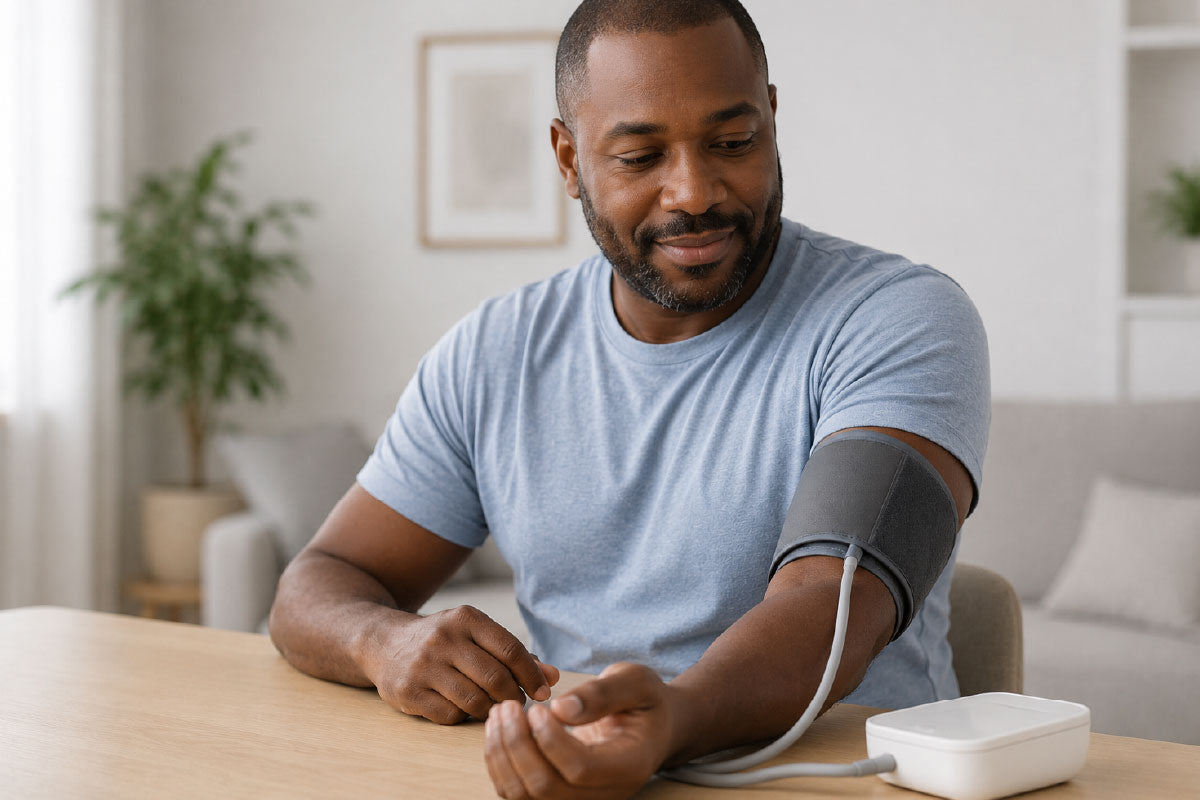
Cardiology groups recommend an automatic monitor with a cuff that goes around the upper arm and has been independently validated. The American Heart Association advises against finger monitors and has strong reservations about wrist monitors, which are harder to position correctly, unless an upper-arm cuff can’t be used (Muntner et al., 2019; Jones et al., 2025).
Cuff size matters too. A cuff that is too small tends to read too high, and one that is too large tends to read too low. Measure around the middle of your upper arm, halfway between shoulder and elbow, and check that the measurement falls within the arm-size range marked on the cuff (Muntner et al., 2019).
One caveat matters after 65: automatic home monitors have mostly been tested in people with a regular heart rhythm, and evidence on how accurate they are in atrial fibrillation is limited. If you have an irregular heartbeat, ask your doctor how best to measure at home (Jones et al., 2025; Muntner et al., 2019).
The guideline recommends device criteria, not specific products.
How should you take home readings after 65?
For a home log that gives your doctor something to work with, the recommended routine is simple and fixed (Muntner et al., 2019; ACC CardioSmart, 2026):
- Take two readings at least one minute apart in the morning, before taking any blood pressure medication.
- Take two more in the evening, before bed.
- Do this for at least three days and preferably seven, at the same times each day.
- Ask your doctor how often to measure after that.
How you sit matters too. Before a reading (Muntner et al., 2019; ACC CardioSmart, 2026):
- Avoid caffeine, exercise, and smoking for 30 minutes, and empty your bladder.
- Sit quietly for at least five minutes with your back supported, feet flat, and legs uncrossed. Stay still and do not talk or use your phone during the rest period or the readings.
- Rest your arm on a table at heart level, with the cuff on bare skin.
Crossing your legs or letting your arm hang down at your side can raise a reading.
Blood pressure can also differ between arms. Doctors usually check both arms at the first visit and then use the arm with the consistently higher reading. A difference of 10 mmHg or more in either number that keeps showing up is worth discussing with your doctor (Muntner et al., 2019; Clark et al., 2021).
Dr. Tomas Bothe, M.D., Ph.D., Chief Medical Officer at Hilo, sums up the practical core: "Use a validated upper-arm monitor with a cuff that fits, and follow a consistent measuring routine. Share the readings with your care team so they can assess the average in context."
Which numbers matter for blood pressure monitoring after 65?
Under the 2025 AHA/ACC guideline, blood pressure categories are based on the average of readings taken on at least two occasions in a health care setting. Your doctor interprets how your home readings fit these categories (Jones et al., 2025).
| Category | Top number (systolic) | Bottom number (diastolic) |
|---|---|---|
| Normal | below 120 AND | below 80 mmHg |
| Elevated | 120 to 129 AND | below 80 mmHg |
| Stage 1 high blood pressure | 130 to 139 OR | 80 to 89 mmHg |
| Stage 2 high blood pressure | 140 or higher OR | 90 or higher mmHg |
For most adults with high blood pressure, the treatment goal is below 130/80 mmHg. The guideline also encourages a systolic target below 120 mmHg when feasible, with the target individualized by your clinician and treatment monitored for side effects. Medication is generally recommended at an average of 140/90 mmHg or higher, and at 130/80 mmHg or higher for people with cardiovascular disease, diabetes, chronic kidney disease, or a higher estimated risk of heart disease and stroke, or when blood pressure stays at 130/80 or above after three to six months of lifestyle changes. Consult your doctor to discuss what is the right threshold for you (Jones et al., 2025).
Age 65 alone does not change these categories or automatically mean a higher treatment goal. Your doctor will consider your overall health, how well you tolerate treatment, and your preferences when agreeing on a target. Frailty or limited life expectancy may call for a different balance of benefits and harms. Tell your doctor about dizziness, fainting, or falls, and review all your medications together (Jones et al., 2025).
If you feel dizzy or lightheaded when you stand up, tell your doctor. This drop on standing is called orthostatic hypotension: a sustained drop of at least 20 mmHg in the top number or 10 mmHg in the bottom number within three minutes of standing. A clinician can check for it by measuring blood pressure after five minutes lying down and again after one and three minutes standing. It is common in older adults and can occur alongside high blood pressure (Saedon et al., 2020; AHA; CDC STEADI).
When very high readings need fast action
Some situations should not wait for a log or a routine (Jones et al., 2025; AHA/ASA):
- Call 911 immediately if you have symptoms of a heart attack or stroke, whatever your blood pressure reading. Do not wait to measure again.
- If a reading is above 180 mmHg systolic and/or above 120 mmHg diastolic and you have symptoms such as chest pain, shortness of breath, back pain, numbness or weakness, a change in vision, or trouble speaking, call 911 immediately.
- Without symptoms, wait at least one minute and measure again; if the reading is still that high, contact your health care professional right away. If symptoms appear, call 911.
Where do cuffless devices fit in?
The 2025 AHA/ACC guideline does not recommend cuffless blood pressure devices for diagnosing or managing high blood pressure, and many of them need regular calibration with a cuff (Jones et al., 2025; Cohen et al., 2026). Nighttime blood pressure patterns are measured with 24-hour ambulatory monitoring, a test your doctor’s office sets up and a clinician interprets.
Hilo Core fits into this picture as a wellness system, not a medical device: an FDA-cleared calibration cuff that provides validated reference measurements, paired with a band and an app that enrich the picture with your blood pressure patterns over time.
The band and app make your blood pressure patterns visible over weeks and give you context to bring to your next appointment. Hilo Core has no diagnosis or treatment function and is not a replacement for cuff readings. Only the calibration cuff is FDA-cleared (not FDA-approved); the band and the Hilo Core system are not FDA-cleared.
How can family members help an older parent keep track?
Family members often make the difference between a routine that lasts and one that fades. Practical support matters most at the start: help with the first readings, then keep the log going at the same times each day.
At appointments, family members can help with the conversation. Bring the log from your validated cuff monitor, ask the doctor about the right target and measuring routine, and report dizziness on standing, falls, fainting, or an irregular heartbeat. A system like Hilo Core is built for exactly this conversation: the FDA-cleared cuff provides the validated reference readings for the log, and the band adds the long-term patterns that give your doctor additional context, clearly labeled as wellness information that complements the cuff readings and never replaces them.
A validated cuff, a steady routine, and your doctor’s view
What cardiologists recommend for blood pressure monitoring after 65 comes down to three things working together: readings from home with a validated upper-arm cuff that fits, a consistent routine at the same times each day, and a doctor who reads the average in context. The conversation with your doctor moves the goal. Bring your log, your questions, and anything you have noticed, and let the pattern, not a single reading, inform the next step.
Find out which blood pressure monitor suits you.
Understand your blood pressure patterns after 65
Hilo Core pairs an FDA-cleared calibration cuff with a band and app that show how your blood pressure patterns evolve over weeks, giving your next appointment more context.
Get Hilo CoreFAQ
What is a normal blood pressure for adults over 65?
Under the 2025 AHA/ACC guideline, normal is a top number below 120 and a bottom number below 80 mmHg, based on the average of readings on at least two occasions in a health care setting. Elevated is 120 to 129 with a bottom number below 80; stage 1 high blood pressure is 130 to 139 or 80 to 89; stage 2 is 140 or higher or 90 or higher. Age 65 alone does not change these categories. Your doctor interprets how your home readings fit them.
How often should older adults measure blood pressure at home?
For a home log, take two readings at least one minute apart in the morning before any blood pressure medication and two in the evening before bed, for at least three days and preferably seven, at the same times each day. After that first week, ask your doctor how often to keep measuring.
Which arm should I use for home blood pressure readings?
Blood pressure can differ between arms. Doctors usually check both arms at the first visit and then use the arm with the consistently higher reading for all later measurements. A difference of 10 mmHg or more in either number that keeps showing up is worth discussing with your doctor.
Are wrist or cuffless monitors recommended for older adults?
Cardiology groups recommend an automatic, independently validated upper-arm monitor; the American Heart Association advises against finger monitors and has strong reservations about wrist monitors unless an upper-arm cuff can’t be used. The 2025 AHA/ACC guideline does not recommend cuffless devices for diagnosing or managing high blood pressure, and many of them need regular calibration with a cuff. Share readings from your validated cuff monitor with your care team. A system like Hilo Core pairs the validated cuff readings with the band’s long-term patterns, giving your doctor both in one place. Cuffless wellness information does not replace these readings and should not guide medication changes.
What if my reading is very high but I feel fine?
If a reading is above 180 mmHg systolic and/or above 120 mmHg diastolic and you have no symptoms, wait at least one minute and measure again. If the reading is still that high, contact your health care professional right away. If symptoms appear, such as chest pain, shortness of breath, back pain, numbness or weakness, a change in vision, or trouble speaking, call 911 immediately, whatever the reading says. Do not wait to measure again.
Disclaimer: Hilo Core is a wellness product. It is not intended to diagnose, treat, cure, or prevent any disease. It is not intended to measure blood pressure for medical purposes. This article is for general informational purposes only and does not constitute medical advice. Individual health decisions should be made in consultation with a qualified healthcare professional. The Hilo Cuff is not intended for people with atrial fibrillation, certain implanted cardiac devices, or other conditions listed in its instructions for use. Check these restrictions before choosing the system. Please consult your healthcare provider before use.
Sources
- J. B. Cohen; R. L. Byfield; S. T. Hardy et al. Cuffless Devices for the Measurement of Blood Pressure: A Scientific Statement From the American Heart Association. Hypertension. 2026;83:876–886. doi:10.1161/HYP.0000000000000254
- D. W. Jones; K. C. Ferdinand; S. J. Taler et al. (2025). 2025 AHA/ACC/AANP/AAPA/ABC/ACCP/ACPM/AGS/AMA/ASPC/NMA/PCNA/SGIM Guideline for the Prevention, Detection, Evaluation, and Management of High Blood Pressure in Adults: A Report of the American College of Cardiology/American Heart Association Joint Committee on Clinical Practice Guidelines. Journal of the American College of Cardiology, 86(18), 1567–1678. https://doi.org/10.1016/j.jacc.2025.05.007
- C. E. Clark; F. C. Warren; K. Boddy et al. (2021). Associations Between Systolic Interarm Differences in Blood Pressure and Cardiovascular Disease Outcomes and Mortality: Individual Participant Data Meta-Analysis, Development and Validation of a Prognostic Algorithm: The INTERPRESS-IPD Collaboration. Hypertension, 77(2), 650–661. https://doi.org/10.1161/HYPERTENSIONAHA.120.15997
- N. I. Saedon; M. P. Tan; J. Frith (2020). The Prevalence of Orthostatic Hypotension: A Systematic Review and Meta-Analysis. The Journals of Gerontology: Series A, 75(1), 117–122. https://doi.org/10.1093/gerona/gly188
- P. Muntner; D. Shimbo; R. C. Carey et al. (2019). Measurement of Blood Pressure in Humans: A Scientific Statement From the American Heart Association. Hypertension, 73(5), e35–e66. https://doi.org/10.1161/HYP.0000000000000087
- K. L. Tucker; J. P. Sheppard; R. Stevens et al. (2017). Self-monitoring of blood pressure in hypertension: a systematic review and individual patient data meta-analysis. PLOS Medicine, 14(9), e1002389. https://doi.org/10.1371/journal.pmed.1002389
- Hypertension in adults: screening. U.S. Preventive Services Task Force. https://www.uspreventiveservicestaskforce.org/uspstf/recommendation/hypertension-in-adults-screening (Accessed October 2026)
- How to take your blood pressure at home. ACC CardioSmart. https://www.cardiosmart.org/docs/default-source/assets/fact-sheet/how-to-take-your-blood-pressure-at-home.pdf (Accessed October 2026)
- Orthostatic hypotension in adults with hypertension. American Heart Association. https://professional.heart.org/en/science-news/orthostatic-hypotension-in-adults-with-hypertension (Accessed October 2026)
- Measuring orthostatic blood pressure. CDC STEADI. https://www.cdc.gov/steadi/media/pdfs/STEADI-Assessment-MeasuringBP-508.pdf (Accessed October 2026)
- When to call 911 for high blood pressure. American Heart Association / American Stroke Association. https://www.stroke.org/en/health-topics/high-blood-pressure/understanding-blood-pressure-readings/when-to-call-911-for-high-blood-pressure (Accessed October 2026)
- Heart attack warning signs. American Heart Association. https://www.heart.org/en/health-topics/heart-attack/warning-signs-of-a-heart-attack (Accessed October 2026)
- Stroke symptoms. American Stroke Association. https://www.stroke.org/en/about-stroke/stroke-symptoms (Accessed October 2026)
Read more

Approximately 28 million Americans are currently uninsured, and nearly half of all US adults have high blood pressure (CDC, 2024). This guide walks through three practical options — from free pharm...

You’re taking your medication. You’ve cut back on salt. And yet, your blood pressure is still too high. In most cases, there’s a specific, fixable reason — but your doctor can only work with what t...
According to the American Heart Association, approximately 58% of Black adults in the US live with high blood pressure.