

Why does blood pressure fluctuate?
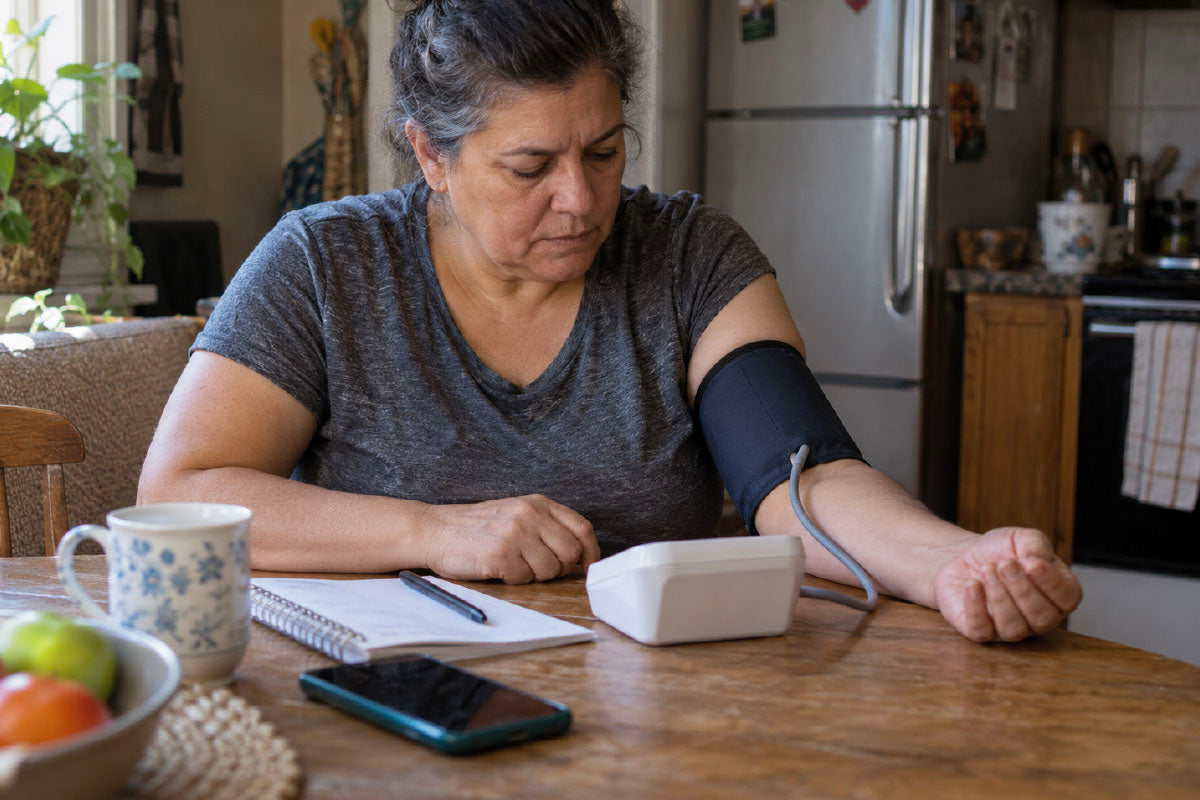
You check your blood pressure before breakfast, check it again after an evening walk, and get two different numbers. Which one is real? Usually both are. In most cases, blood pressure fluctuation is a normal part of how the body works: your blood pressure follows a daily rhythm, and the conditions around a single check can move the number as well. Below, we look at that daily rhythm, the nighttime pattern worth knowing about, why the same reading can look different depending on how it is taken, and one common, often overlooked driver.
Key facts
- A daily rhythm is normal: Blood pressure usually starts rising before you wake, peaks around midday, drops in the late afternoon and evening, and is usually lower during sleep.
- Nighttime blood pressure is worth knowing about: Higher blood pressure during sleep is associated with increased cardiovascular risk, independent of your blood pressure while awake.
- How you measure matters: Posture, recent caffeine or exercise, and the setting of a check can all move a single reading, so one number reflects the conditions of that moment.
- See your own rhythm: Hilo Core helps you understand your own blood pressure patterns across days and nights over time.
The normal rhythm: how blood pressure fluctuates through a day and night
Your blood pressure moves in a pattern that tracks your sleep-wake cycle. According to the Mayo Clinic, blood pressure usually starts to rise a few hours before a person wakes up and continues to rise during the day, peaking around midday. It typically drops in the late afternoon and evening, and it is usually lower at night while sleeping.
The American Heart Association's scientific statement on blood pressure measurement describes the two ends of that cycle. Normally, blood pressure decreases during sleep, a pattern called nocturnal dipping, and it rises rapidly when people awaken.
That nighttime dip is a normal part of the pattern. A lower number overnight and a higher one later in the day are both expected, and this daily rhythm is ordinary physiology. It is also one reason two checks taken at different times of day can show different values.
When the nighttime dip doesn't happen as expected
The overnight part of the daily rhythm is where one clinically meaningful pattern shows up. The AHA scientific statement defines it by the size of the dip: a decline in blood pressure of 10% or more from awake to asleep counts as dipping, and a decline of less than 10% counts as nondipping.
The overnight hours matter for a specific reason. According to the same statement, higher blood pressure during sleep is associated with increased cardiovascular risk, independent of blood pressure while awake. Your nighttime numbers belong in the full picture alongside your daytime ones.
This pattern is easy to miss. A single reading captures your blood pressure in one moment; it shows you a value, but not the pattern behind it, and a daytime office visit cannot show what happens overnight. Recognition of nocturnal hypertension and abnormal dipping patterns has come mainly from ambulatory blood pressure monitoring, which takes automatic readings across a full day and night; home blood pressure monitoring has contributed as well, though its role for nighttime patterns is newer and less established (A. Tang; E. Yang; J. E. Ebinger, 2024).
Why the same reading can look different depending on how it's taken
The daily rhythm described above is real physiological change. Some of what looks like blood pressure fluctuation, however, comes from the conditions of the measurement itself: where, when, and how a reading is taken.
The AHA scientific statement on blood pressure measurement sets out how a reading should be taken:
- Posture: sit relaxed in a chair with your feet flat on the floor and your back supported.
- Rest first: stay seated for 3–5 minutes without talking or moving around before the first reading.
- Timing: avoid caffeine, exercise, and smoking for at least 30 minutes before measuring.

Skipping these steps can move the number, and the American Heart Association also notes that exercise, caffeine or even stress can temporarily raise your blood pressure. A higher number right after coffee or a brisk walk is a short-lived, expected response.
Setting plays a role too. Two named patterns describe a gap between blood pressure in the office and blood pressure outside it, and both are measurement-context patterns. According to the 2025 AHA/ACC hypertension guideline, masked hypertension means blood pressure is not high in the office but high outside it, based on readings taken outside the office in daily life. White coat hypertension is the reverse: high in the office, not high outside it. The same guideline notes that white coat hypertension is associated with no risk to a moderately increased risk of cardiovascular disease. Both describe where blood pressure was measured; neither is a cause of blood pressure fluctuation.
This does not mean your blood pressure is erratic. Each reading is a snapshot of one moment, including the conditions of that moment.
A common, overlooked driver: sleep apnea
Obstructive sleep apnea (OSA) involves repeated breathing interruptions during sleep, and it is a recognized cause of secondary hypertension. OSA episodes produce surges in systolic and diastolic pressure that keep average blood pressure elevated at night, and in many patients blood pressure remains elevated during the daytime, when breathing is normal (J. M. Dopp; K. J. Reichmuth; B. J. Morgan, 2007).
This links back to the nighttime dip. The 2025 AHA/ACC guideline lists loss of the normal nocturnal blood pressure fall among the exam findings that point toward sleep apnea. The same guideline names the signs worth raising with a clinician:
- Snoring during sleep
- Choking or gasping during sleep
- Daytime sleepiness
If these sound familiar, ask your doctor whether an evaluation for sleep apnea is appropriate. Per the 2025 AHA/ACC guideline, screening starts with a short questionnaire such as STOP-Bang or the Berlin questionnaire, or with overnight oximetry. A sleep study, either polysomnography or a home sleep apnea test, is the confirmatory step that follows a referral.
For people with obstructive sleep apnea, CPAP can modestly lower blood pressure: according to the 2025 AHA/ACC guideline, it can reduce high office and ambulatory blood pressure by 2 to 5 mm Hg.
Seeing your own pattern, not just one reading
Hilo Core is designed to help you understand how your daily habits relate to your blood pressure patterns over time. Each section above returns to the same point: a single reading is a real data point that captures one moment.
The Hilo Core Band and app add that longer view, showing how your blood pressure trends across days and nights over weeks. The system is anchored by a validated upper-arm cuff, which provides the reference measurements used to calibrate the band.
Seeing your own rhythm over time gives you long-term context to reflect on, and more to share with your doctor at your next appointment.
Blood pressure fluctuation follows a rhythm you can learn
Blood pressure fluctuation across the day and night is usually a normal, expected part of how the body works (Mayo Clinic). The overnight part of the pattern is worth paying attention to, because higher blood pressure during sleep is associated with increased cardiovascular risk (American Heart Association). Some apparent swings come from the conditions of a measurement, and sleep apnea is a checkable driver when the nighttime pattern looks off (2025 AHA/ACC guideline). Understanding your own rhythm over time gives you more to work with than any single number.
See your patterns, not just a number
Hilo Core pairs a validated cuff with everyday trend data from your band and app, so you and your doctor have more context than one reading can give.
Get Hilo CoreFAQ
Is it normal for blood pressure to be different in the morning than at night?
Yes. Blood pressure follows a daily rhythm: according to the Mayo Clinic, it usually starts to rise a few hours before you wake up, continues rising during the day, peaks around midday, and typically drops in the late afternoon and evening. At night while you sleep, it is usually lower. A morning check and an evening check can therefore show different numbers, and that difference on its own is expected.
What does it mean if blood pressure doesn't drop at night?
According to the AHA scientific statement on blood pressure measurement, blood pressure normally decreases during sleep, and when it falls by less than 10% from awake to asleep levels, the pattern is called nondipping. The same statement notes that higher blood pressure during sleep is associated with increased cardiovascular risk, independent of awake blood pressure. Because a daytime office visit cannot show what happens overnight, this is a pattern worth discussing with your doctor.
Can stress or exercise cause a blood pressure reading to change?
Yes. The American Heart Association notes that exercise, caffeine or even stress can temporarily raise your blood pressure. That is why its scientific statement on measurement advises avoiding caffeine, exercise, and smoking for at least 30 minutes before a reading, and sitting quietly for 3–5 minutes with your back supported and feet flat on the floor first. A higher number right after a workout or a stressful moment is a temporary, expected response.
Can sleep apnea cause blood pressure to fluctuate?
Obstructive sleep apnea is a recognized cause of secondary hypertension. Its episodes produce surges in blood pressure that keep average levels elevated at night, and in many people during the day as well (J. M. Dopp; K. J. Reichmuth; B. J. Morgan, 2007). The 2025 AHA/ACC guideline names snoring, choking or gasping during sleep, and daytime sleepiness as signs worth raising with a clinician. Screening starts with a questionnaire or overnight oximetry, and a sleep study after referral confirms it.
Disclaimer: Hilo Core is a wellness product. It is not intended to diagnose, treat, cure, or prevent any disease. It is not intended to measure blood pressure for medical purposes. This article is for general informational purposes only and does not constitute medical advice. Individual health decisions should be made in consultation with a qualified healthcare professional. Hilo Core is not recommended during pregnancy or for individuals with certain cardiac implants or pre-existing conditions. Please consult your healthcare provider before use.
Sources
- D. W. Jones; K. C. Ferdinand; S. J. Taler et al. (2025). 2025 AHA/ACC/AANP/AAPA/ABC/ACCP/ACPM/AGS/AMA/ASPC/NMA/PCNA/SGIM Guideline for the Prevention, Detection, Evaluation, and Management of High Blood Pressure in Adults: A Report of the American College of Cardiology/American Heart Association Joint Committee on Clinical Practice Guidelines. Hypertension, 82, e212–e316.
https://doi.org/10.1161/HYP.0000000000000249
(Accessed October 2026) - A. Tang; E. Yang; J. E. Ebinger (2024). Non-Dipping Blood Pressure or Nocturnal Hypertension: Does One Matter More? Current Hypertension Reports, 26, 21–30.
https://doi.org/10.1007/s11906-023-01273-1
(Accessed October 2026) - P. Muntner; D. Shimbo; R. M. Carey et al. (2019). Measurement of Blood Pressure in Humans: A Scientific Statement From the American Heart Association. Hypertension, 73(5), e35–e66.
https://doi.org/10.1161/HYP.0000000000000087
(Accessed October 2026) - J. M. Dopp; K. J. Reichmuth; B. J. Morgan (2007). Obstructive sleep apnea and hypertension: mechanisms, evaluation, and management. Current Hypertension Reports, 9(6), 529–534.
https://pubmed.ncbi.nlm.nih.gov/18367017/
(Accessed October 2026) - Blood pressure: Does it have a daily pattern? Mayo Clinic.
https://www.mayoclinic.org/diseases-conditions/high-blood-pressure/expert-answers/blood-pressure/faq-20058115
(Accessed October 2026) - Blood Pressure Explained: A Helpful Guide. American Heart Association.
https://www.heart.org/en/health-topics/high-blood-pressure/blood-pressure-explained
(Accessed October 2026)
Read more

Blood pressure naturally rises in the early-morning hours as part of the body's daily rhythm, so a higher morning reading is often normal. Here is what is ordinary, what doctors mean by a morning s...
A single number on a cuff display used to be the whole story. Then the guidelines moved the line for high blood pressure lower than the number most people memorized. Here is what current guidance a...
Measuring your blood pressure correctly means the number on the screen should reflect your resting body, not the rush that got you there. Small, fixable steps in preparation and positioning have a ...